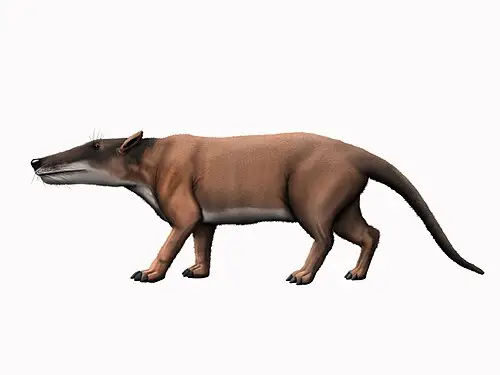
 🎨 Restoration
Restoration: Zerosmany · CC BY-SA 4.0 · Wikimedia Commons Source
Life restorations are artistic reconstructions based on fossil evidence; true coloration and soft-tissue details remain uncertain.
Pakicetus
Pakicetus inachus (Pakicetus · Pakicetus)
Known only from fossils. The IUCN Red List assesses only species extant since 1500 CE, so fossil taxa are not assigned a category.
💡 Everyday Comparisons for Size, Mass & Speed
- 💡 Just as it is hard for a person to tell the direction of sounds with their head underwater in a swimming pool, the ear of Pakicetus was not suited for directional hearing underwater (Comparison).
- 💡 It is introduced as a fossil that supported the view that the distant ancestors of the whales seen in aquariums and oceans today came from a lineage of terrestrial mammals (1983 Science paper).
Reference standards: coach bus ~12 m, mid-size car ~4.9 m, compact car ~1 t, basketball hoop 3.05 m, credit card 8.56 cm.
📖 1. Overview
Pakicetus inachus (genus Pakicetus) is an animal from the early Eocene of Pakistan known as the oldest and most primitive whale. It was discovered in river deposits alongside a land-mammal fauna.
🦴 2. Anatomy & Morphology
Its teeth resembled those of carnivorous land mammals (mesonychids), and its ear region lacked the specializations seen in modern whales for directional hearing underwater.
🔍 3. Fossil Record & Paleoecology
A 1983 Science paper interpreted whales as having evolved from terrestrial carnivorous mammals and gradually transitioned to aquatic life while feeding on fish in shallow seas.
🇰🇷 4. Connection to Korea
No direct record connecting this species to Korea has been found.
📚 Sources & References
- • Fossil taxon — the IUCN Red List assesses only species living or extinct since 1500
- • paleobiodb.org — basicTaxonInfo
- • wikidata.org — Q124488387
- • commons.wikimedia.org — File:Pakicetus inachus.jpg
- • science.org — science.220.4595.403
- • Silhouette: PhyloPic — Conty · CC BY 3.0 (Congeneric silhouette — Pakicetus)
Recorded dimensions are widely cited representative estimates from public literature and may vary by study or specimen.