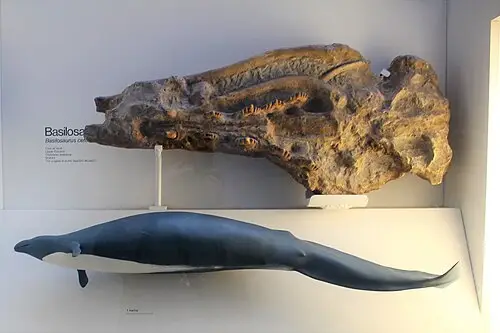
 🎨 Restoration
Restoration: Emőke Dénes · CC BY-SA 4.0 · Wikimedia Commons Source
Life restorations are artistic reconstructions based on fossil evidence; true coloration and soft-tissue details remain uncertain.
Basilosaurus
Basilosaurus cetoides (Basilosaurus · Basilosaurus)
Known only from fossils. The IUCN Red List assesses only species extant since 1500 CE, so fossil taxa are not assigned a category.
💡 Everyday Comparisons for Size, Mass & Speed
- 💡 A body length of about 20 m is similar to the length of 1.7 city buses (about 12 m) placed end to end (Comparison).
- 💡 The U.S. state of Alabama designated it as its official state fossil, and the Smithsonian National Museum of Natural History has exhibited a skeleton assembled from fossils collected in Alabama since 1910.
Reference standards: coach bus ~12 m, mid-size car ~4.9 m, compact car ~1 t, basketball hoop 3.05 m, credit card 8.56 cm.
📖 1. Overview
Basilosaurus cetoides belongs to Basilosaurus, a group of whales that lived at the end of the Eocene about 34–35 million years ago and was first mistaken for a reptile. It is the state fossil of Alabama in the United States.
🦴 2. Anatomy & Morphology
With a long, snake-like body, it is said to have grown to 18–20 m in length. Its double-rooted teeth proved that it was a mammal rather than a reptile, and reduced hind limbs and toes were confirmed in the closely related species B. isis.
🔍 3. Fossil Record & Paleoecology
It is thought to have been a predator that hunted large fish and other vertebrates in shallow seas. Most knowledge of it comes from fossils found in Alabama, and the Smithsonian Museum has displayed its skeleton since 1910.
🇰🇷 4. Connection to Korea
No direct record connecting this species to Korea has been found.
📚 Sources & References
- • Fossil taxon — the IUCN Red List assesses only species living or extinct since 1500
- • paleobiodb.org — basicTaxonInfo
- • wikidata.org — Q41162855
- • commons.wikimedia.org — File:Basilosaurus cetoides (1).jpg
- • encyclopediaofalabama.org — basilosaurus-cetoides
- • Silhouette: PhyloPic — Chris Forbes · CC BY 4.0 (Congeneric silhouette — Basilosaurus)
Recorded dimensions are widely cited representative estimates from public literature and may vary by study or specimen.