 📸 Photo
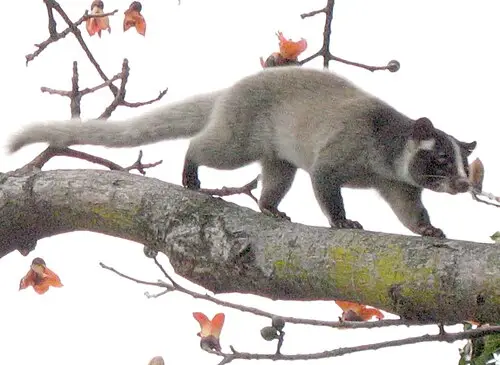
Photo: Denise Chan from Hong Kong, China · CC BY-SA 2.0 · Wikimedia Commons Source
Masked Palm Civet
Paguma larvata (Masked Palm Civet · ハクビシン)
💡 Everyday Comparisons for Size, Mass & Speed
- 💡 A body length of 76 cm is about 2.6 times the long side of an A4 sheet of paper (29.7 cm) (Comparison).
- 💡 A weight of 5 kg is half of a 10 kg bag of rice (Comparison).
- 💡 It is hunted for fur and meat, and in some villages it is kept as a pet or used to catch rats (ADW).
Reference standards: coach bus ~12 m, mid-size car ~4.9 m, compact car ~1 t, basketball hoop 3.05 m, credit card 8.56 cm.
Site-computed relative index from recorded values; not a formal scientific metric.
📖 1. Overview
The Masked Palm Civet is an arboreal, nocturnal, solitary fruit-eating civet considered one of the most widespread civet species, often seen in forests near human villages.
🦴 2. Anatomy & Morphology
Its short gray coat is tinged with orange and buff without spots or stripes, and its blackish feet each have 5 retractable claws. A white stripe from the top of the head to the nose and white marks above the eyes form a "mask."
🔍 3. Ecology & Behavior
It feeds mainly on fruit along with small vertebrates, insects, and birds. Sleeping in high treetop "day beds" by day and foraging at night, it can travel up to 2 km a day, and breeds in early spring and late autumn with litters of 1–4 young.
🇰🇷 4. Connection to Korea
No direct record connecting this species to Korea has been found.
📚 Sources & References
- • IUCN Red List LC (2024) — https://www.iucnredlist.org/species/41692/259351893
- • IUCN Red List category LC — latest assessment at iucnredlist.org
- • mammaldiversity.org — 1006099
- • iucnredlist.org — 259351893
- • wikidata.org — Q626049
- • commons.wikimedia.org — File:Palm civet on tree (detail).jpg
- • animaldiversity.org — Paguma larvata
- • Silhouette: PhyloPic — Margot Michaud · CC0 1.0
Recorded dimensions are widely cited representative estimates from public literature and may vary by study or specimen.