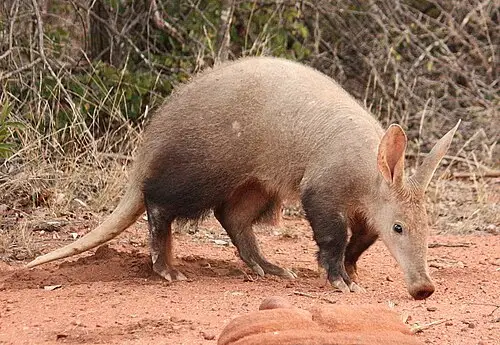
 📸 Photo
Photo: Kelly Abram · CC BY 4.0 · Wikimedia Commons Source
Aardvark
Orycteropus afer (Aardvark · ツチブタ)
💡 Everyday Comparisons for Size, Mass & Speed
- 💡 Abandoned burrows serve as homes for hyenas, warthogs, and mongooses, though they can also be hazards for vehicles.
- 💡 A maximum body length of 1.58 m is slightly shorter than the height of an adult human (about 1.7 m) (Comparison).
- 💡 A maximum weight of 82 kg is about four 20 kg bags of rice (Comparison).
Reference standards: coach bus ~12 m, mid-size car ~4.9 m, compact car ~1 t, basketball hoop 3.05 m, credit card 8.56 cm.
Site-computed relative index from recorded values; not a formal scientific metric.
📖 1. Overview
The Aardvark is a burrowing mammal of sub-Saharan African grasslands that forages at night for ants and termites.
🦴 2. Anatomy & Morphology
It has a long snout with a squared-off tip, very thick skin, spade-like claws on its 4 front toes and 5 hind toes, and no incisors or canines.
🔍 3. Ecology & Behavior
Ants and termites make up almost all of its diet, which it sweeps up with its long, sticky tongue. When threatened, it can dig a hole to hide in within 10 minutes.
🇰🇷 4. Connection to Korea
No direct record connecting this species to Korea has been found.
📚 Sources & References
- • IUCN Red List LC (2015) — https://www.iucnredlist.org/species/41504/21286437
- • IUCN Red List category LC — latest assessment at iucnredlist.org
- • mammaldiversity.org — 1000520
- • iucnredlist.org — 21286437
- • wikidata.org — Q46212
- • commons.wikimedia.org — File:Orycteropus afer 175359469 (cropped).jpg
- • animaldiversity.org — Orycteropus afer
- • Silhouette: PhyloPic — Kai Caspar · CC0 1.0
Recorded dimensions are widely cited representative estimates from public literature and may vary by study or specimen.