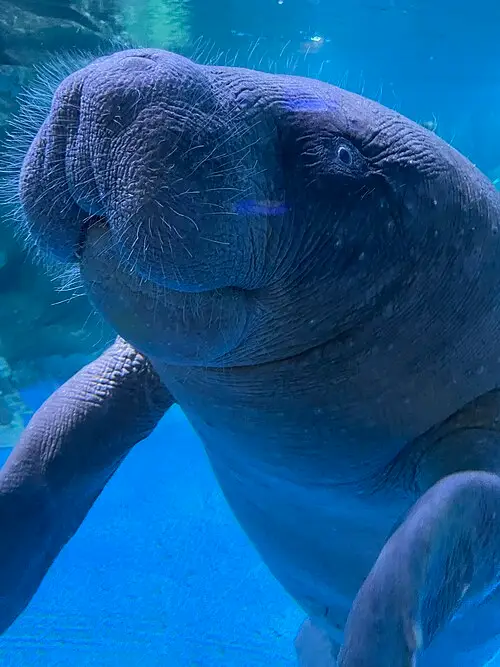
 📸 Photo
Photo: Gameraquai · CC0 · Wikimedia Commons Source
West African Manatee
Trichechus senegalensis (West African Manatee · アフリカマナティー)
💡 Everyday Comparisons for Size, Mass & Speed
- 💡 In villages in Sierra Leone and Nigeria, people catch it with snares and harpoons for meat; its meat, hide, bones, and oil are used.
- 💡 Its maximum weight of 750 kg is about thirty-seven and a half 20 kg bags of rice (Comparison).
- 💡 Eating up to 8,000 kg of aquatic plants per year works out to just over 20 kg a day—about one bag of rice worth of plants daily (Comparison).
Reference standards: coach bus ~12 m, mid-size car ~4.9 m, compact car ~1 t, basketball hoop 3.05 m, credit card 8.56 cm.
Site-computed relative index from recorded values; not a formal scientific metric.
📖 1. Overview
The West African Manatee lives in coastal waters and rivers of West Africa and resembles the West Indian Manatee.
🦴 2. Anatomy & Morphology
Its body is grayish brown with white hairs. Compared to the West Indian Manatee, its snout is blunter and its small eyes protrude more.
🔍 3. Ecology & Behavior
Aquatic vascular plants make up most of its diet. It also eats mangrove leaves and grasses overhanging the water's edge, and an adult can consume up to 8,000 kg a year. It usually lives alone but may gather in groups of up to 15 for food. Its gestation period is about 13 months.
🇰🇷 4. Connection to Korea
No direct record connecting this species to Korea has been found.
📚 Sources & References
- • IUCN Red List VU (2015) — https://www.iucnredlist.org/species/22104/97168578
- • IUCN Red List category VU — latest assessment at iucnredlist.org
- • mammaldiversity.org — 1000533
- • iucnredlist.org — 97168578
- • wikidata.org — Q387297
- • commons.wikimedia.org — File:African manatee at Coex Aquarium, South Korea.jpg
- • sealifebase.se — SpeciesSummary.php
- • marine-mammals.linnaeus.naturalis.nl — taxon.php
- • animaldiversity.org — Trichechus senegalensis
- • Silhouette: PhyloPic — author not recorded · CC0 1.0
Recorded dimensions are widely cited representative estimates from public literature and may vary by study or specimen.