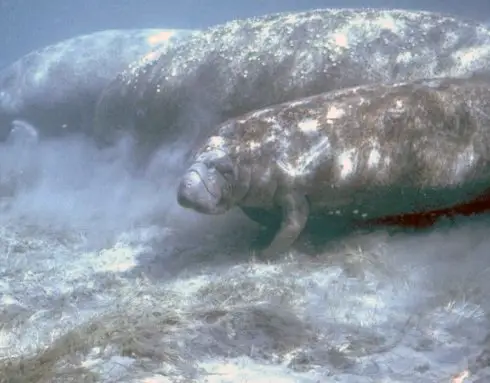
 📸 Photo
Photo: Public domain · Public domain · Wikimedia Commons Source
West Indian Manatee
Trichechus manatus (West Indian Manatee · ニシインドマナティー)
💡 Everyday Comparisons for Size, Mass & Speed
- 💡 Its average body length of about 3 m is about 2/3 the length of a passenger car (about 4.5 m) (Comparison).
- 💡 Designated as the official marine mammal of Florida, USA, it attracts many tourists (the Florida manatee is a subspecies of this species).
- 💡 It was once proposed for clearing aquatic weeds, but it did not eat enough to be useful.
Reference standards: coach bus ~12 m, mid-size car ~4.9 m, compact car ~1 t, basketball hoop 3.05 m, credit card 8.56 cm.
Site-computed relative index from recorded values; not a formal scientific metric.
📖 1. Overview
The West Indian Manatee is a slow-moving herbivorous marine mammal living in warm shallow waters that feeds on seagrass.
🦴 2. Anatomy & Morphology
It has a seal-like body with forelimbs shaped into flippers fully adapted to aquatic life. Adults are gray or brown while young are darker. Its split upper lip passes food into the mouth.
🔍 3. Ecology & Behavior
It feeds mainly on seagrass on the bottom and also digs up roots with its flippers. Having no natural predators, it lives mostly alone and forms loose aggregations. When a female is in estrus, up to twenty males follow her for one week to one month.
🇰🇷 4. Connection to Korea
No direct record connecting this species to Korea has been found.
📚 Sources & References
- • IUCN Red List VU (2024) — https://www.iucnredlist.org/species/22103/43792740
- • IUCN Red List category VU — latest assessment at iucnredlist.org
- • mammaldiversity.org — 1000532
- • iucnredlist.org — 43792740
- • wikidata.org — Q40261
- • commons.wikimedia.org — File:Manatee.jpg
- • animaldiversity.org — Trichechus manatus
- • Silhouette: PhyloPic — Flurin Leugger · CC BY 4.0 (Congeneric silhouette — Trichechus)
Recorded dimensions are widely cited representative estimates from public literature and may vary by study or specimen.