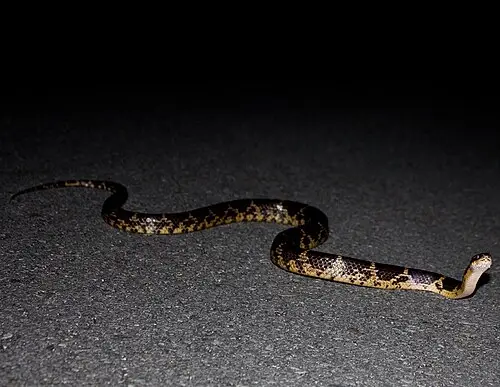
 📸 Photo
Photo: Koolah ( talk ) · CC BY-SA 3.0 · Wikimedia Commons Source
Red-banded Snake
Dinodon rufozonatus (Red-banded Snake · Red-banded Snake)
💡 Everyday Comparisons for Size, Mass & Speed
- 💡 Its maximum length of 1.2 m is slightly longer than a long umbrella (Comparison).
- 💡 The National List of Species of Korea notes that because it is nocturnal, many individuals are run over by cars on roads at night; living around farmlands and homes, its range overlaps with human living spaces.
Reference standards: coach bus ~12 m, mid-size car ~4.9 m, compact car ~1 t, basketball hoop 3.05 m, credit card 8.56 cm.
📖 1. Overview
The Red-banded Snake is a non-venomous snake living in farmlands, around houses, and in low hills throughout Korea, active at night.
🦴 2. Anatomy & Morphology
It has numerous red and black crossbands on its back, a long row of black blotches along its flanks, and a flattened snout tip. Though fierce in temperament, its teeth are small, so bites do not cause serious injury to humans or large animals.
🔍 3. Ecology & Behavior
Hiding under rocks or tree stumps by day, it emerges at night to prey on toads, frogs, mice, small birds, other snakes, and fish. It lays about 10 eggs, enters hibernation in mid-October, and wakes around April of the following year.
🇰🇷 4. Connection to Korea
Listed as "Neunggureongi" (Korean name) in the National List of Species of Korea, it inhabits all of Korea and is frequently killed by cars on roads at night.
📚 Sources & References
- • IUCN Red List LC (2017) — https://www.iucnredlist.org/species/192124/2043244
- • IUCN Red List category LC — latest assessment at iucnredlist.org
- • catalogueoflife.org — 3WL42
- • iucnredlist.org — 2043244
- • 국가생물종목록(국립생물자원관) ktsn 120000059481 — https://species.nibr.go.kr/home/mainHome.do?cont_link=009&subMenu=009002&contCd=009002&ktsn=120000059481
- • wikidata.org — Q107055675
- • species.nibr.go.kr — mainHome.do
- • Silhouette: PhyloPic — Alex Slavenko · CC0 1.0 (Related taxon silhouette — Elaphe quatuorlineata)
Recorded dimensions are widely cited representative estimates from public literature and may vary by study or specimen.