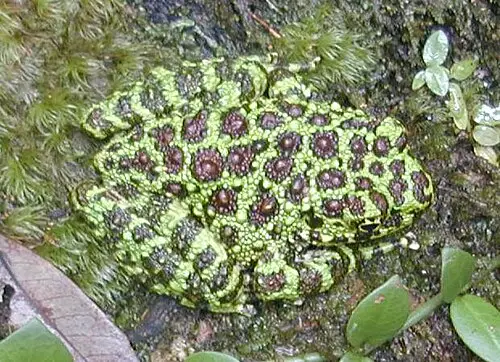
 📸 Photo
Photo: self · CC BY-SA 3.0 · Wikimedia Commons Source
Ishikawa's Frog
Odorrana ishikawae (Ishikawa's Frog · オキナワイシカワガエル)
💡 Everyday Comparisons for Size, Mass & Speed
- 💡 Its maximum length of 115 mm is slightly longer than four Korean 500-won coins (26.5 mm in diameter) lined up side by side (106 mm) (Comparison).
- 💡 In Japan it is designated a Nationally Rare Species of Wild Fauna and Flora that cannot be caught or traded, and roadkill accidents are increasing as forest roads expand (Ministry of the Environment 5th Red Data Book).
Reference standards: coach bus ~12 m, mid-size car ~4.9 m, compact car ~1 t, basketball hoop 3.05 m, credit card 8.56 cm.
📖 1. Overview
Ishikawa's Frog is an endemic species living only along forest mountain streams in northern Okinawa Island, Japan. It is a different species from Amami-ishikawa-gaeguri (a Korean animal name), and the IUCN assesses it as Endangered (EN, 2021).
🦴 2. Anatomy & Morphology
Its back has many cone-shaped tubercles ranging from dark brown to dark reddish purple on a green background, and its limbs have dark bands. The belly is white to pale yellowish white covered with light brown markings.
🔍 3. Ecology & Behavior
The breeding season runs from December to April (peaking in February–March), when it lays eggs in bank holes or rock crevices beside slow-moving mountain streams. Tadpoles usually metamorphose in summer, though some overwinter and metamorphose the following spring, and adults prey on millipedes and freshwater crabs.
🇰🇷 4. Connection to Korea
No direct record connecting this species to Korea has been found.
📚 Sources & References
- • IUCN Red List EN (2021) — https://www.iucnredlist.org/species/54308994/177217696
- • IUCN Red List category EN — latest assessment at iucnredlist.org
- • catalogueoflife.org — 48SFW
- • iucnredlist.org — 177217696
- • wikidata.org — Q2212227
- • commons.wikimedia.org — File:Rana ishikawae.jpg
- • env.go.jp — AM0033 RDB5th.pdf
- • kyushu.env.go.jp — c-4-j.pdf
- • bok.or.kr — contents.do
- • Silhouette: PhyloPic — Beth Reinke · CC0 1.0 (Related taxon silhouette — Rana sierrae)
Recorded dimensions are widely cited representative estimates from public literature and may vary by study or specimen.