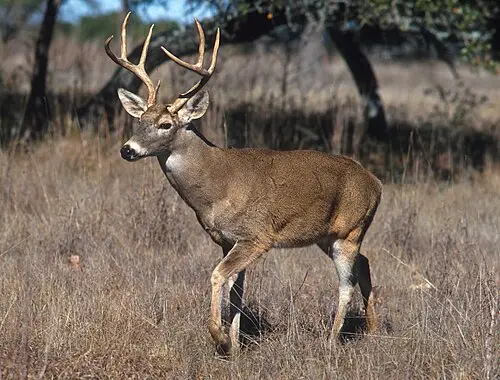
 📸 Photo
Photo: USDA photo by Scott Bauer · Public domain · Wikimedia Commons Source
White-tailed Deer
Odocoileus virginianus (White-tailed Deer · オジロジカ)
💡 Everyday Comparisons for Size, Mass & Speed
- 💡 It is widely hunted for meat and sport, and early settlers and Native Americans made buckskin leather from its hides (Animal Diversity Web).
- 💡 Its running speed of 48 km/h through forests is close to a 50 km/h urban road speed limit (Comparison).
- 💡 A maximum weight of 137 kg equals about 7 twenty-kilogram bags of rice (Comparison).
Reference standards: coach bus ~12 m, mid-size car ~4.9 m, compact car ~1 t, basketball hoop 3.05 m, credit card 8.56 cm.
Site-computed relative index from recorded values; not a formal scientific metric.
📖 1. Overview
The White-tailed Deer is a deer living across a wide range of North American habitats from forests to deserts, easily recognized by the way it waves its tail from side to side when startled and fleeing.
🦴 2. Anatomy & Morphology
Its coat is grayer in winter and redder in summer, with white fur behind the nose, around the eyes, inside the ears, on the chin, and under the tail. It has scent glands between the hooves on all four feet and on its hind legs.
🔍 3. Ecology & Behavior
It feeds on buds, twigs, and various shrubs, foraging mainly around dawn and dusk. A strong swimmer, it breeds from October to December and has a gestation period of about 6.5 months.
🇰🇷 4. Connection to Korea
No direct record connecting this species to Korea has been found.
📚 Sources & References
- • IUCN Red List LC (2016) — https://www.iucnredlist.org/species/42394/22162580
- • IUCN Red List category LC — latest assessment at iucnredlist.org
- • mammaldiversity.org — 1006302
- • iucnredlist.org — 22162580
- • wikidata.org — Q215887
- • commons.wikimedia.org — File:White-tailed deer.jpg
- • animaldiversity.org — Odocoileus virginianus
- • Silhouette: PhyloPic — Gabriela Palomo-Munoz · CC BY 4.0
Recorded dimensions are widely cited representative estimates from public literature and may vary by study or specimen.