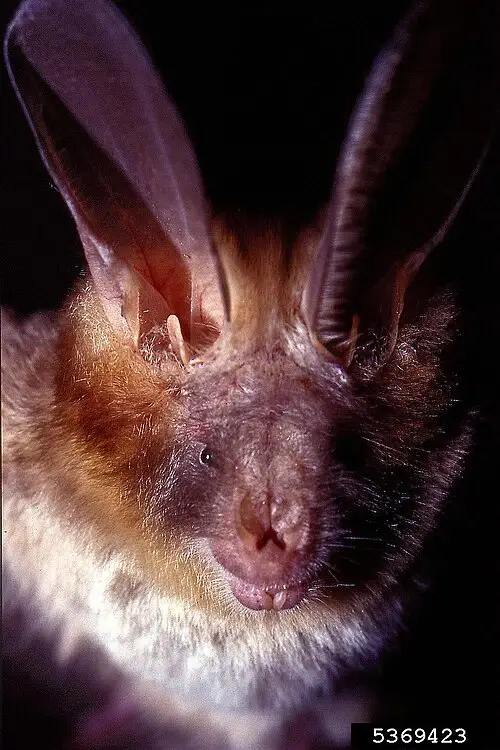
 📸 Photo
Photo: Susan Ellis, Bugwood.org · CC BY 3.0 us · Wikimedia Commons Source
Egyptian Slit-faced Bat
Nycteris thebaica (Egyptian Slit-faced Bat · Egyptian Slit-faced Bat)
💡 Everyday Comparisons for Size, Mass & Speed
- 💡 It also roosts in human-made structures such as tombs, military bunkers, fireplaces, and ruins.
- 💡 A maximum weight of 16 g is just over two Korean 500-won coins (about 7.7 g each) (Comparison).
- 💡 A maximum wingspan of 30.7 cm is nearly equal to the long side of an A4 sheet of paper (29.7 cm) (Comparison).
Reference standards: coach bus ~12 m, mid-size car ~4.9 m, compact car ~1 t, basketball hoop 3.05 m, credit card 8.56 cm.
Site-computed relative index from recorded values; not a formal scientific metric.
📖 1. Overview
The Egyptian Slit-faced Bat is an insect-eating bat with huge ears that lives in dry regions of Africa.
🦴 2. Anatomy & Morphology
Its fur is long and silky, ranging from gray to pale reddish or murky brown, with a white to light gray belly. Its ears are longer than its head, and as a desert- and savanna-dwelling bat its coat color is relatively pale.
🔍 3. Ecology & Behavior
It feeds on moths, spiders, orthopterans, and beetles, with scorpions making up a major share of its diet when available. It catches prey in flight or pounces from a perch, sometimes gathers in colonies of 500–600 in a single cave, and gives birth in November in South Africa.
🇰🇷 4. Connection to Korea
No direct record connecting this species to Korea has been found.
📚 Sources & References
- • IUCN Red List LC (2017) — https://www.iucnredlist.org/species/14936/22014183
- • IUCN Red List category LC — latest assessment at iucnredlist.org
- • mammaldiversity.org — 1004845
- • iucnredlist.org — 22014183
- • wikidata.org — Q1830648
- • commons.wikimedia.org — File:Nycteris thebaica.jpg
- • animaldiversity.org — Nycteris thebaica
Recorded dimensions are widely cited representative estimates from public literature and may vary by study or specimen.