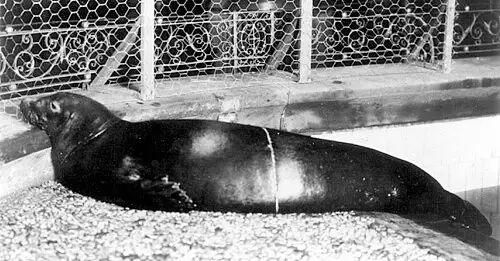
 📸 Photo
Photo: New York Zoological Society. · Public domain · Wikimedia Commons Source
Caribbean Monk Seal
Neomonachus tropicalis (Caribbean Monk Seal · Caribbean Monk Seal)
💡 Everyday Comparisons for Size, Mass & Speed
- 💡 An average body length of about 2.2 m is close to the length of a single bed (about 2 m) (Comparison).
- 💡 The last confirmed record in United States waters was off Texas in 1932, and a small colony was sighted at Serranilla Bank between Honduras and Jamaica in 1952 (ADW).
- 💡 First recorded by Columbus, it was relentlessly hunted by Europeans for oil rendered from its blubber (ADW).
Reference standards: coach bus ~12 m, mid-size car ~4.9 m, compact car ~1 t, basketball hoop 3.05 m, credit card 8.56 cm.
Site-computed relative index from recorded values; not a formal scientific metric.
📖 1. Overview
The Caribbean Monk Seal was the only pinniped native to the Caribbean Sea and is now declared extinct. Its last confirmed record in United States waters was in 1932.
🦴 2. Anatomy & Morphology
Its brown coat had a grayish frosted look that faded to pale yellow on the belly. It had a hood-like roll of fat around the neck, short stiff hair, and four nipples rather than two.
🔍 3. Ecology & Behavior
Because it went extinct before being studied in detail, its exact diet is uncertain, but it is thought to have eaten fish and invertebrates including spiny lobsters, eels, and octopuses. Hunting for oil combined with mass killing by fishermen drove its extinction.
🇰🇷 4. Connection to Korea
No direct record connecting this species to Korea has been found.
📚 Sources & References
- • IUCN Red List EX (2015) — https://www.iucnredlist.org/species/13655/45228171
- • IUCN Red List category EX — latest assessment at iucnredlist.org
- • mammaldiversity.org — 1005922
- • iucnredlist.org — 45228171
- • wikidata.org — Q28173930
- • commons.wikimedia.org — File:Cms-newyorkzoologicalsociety1910.jpg
- • animaldiversity.org — Monachus tropicalis
- • Silhouette: PhyloPic — Zimices · CC BY 3.0
Recorded dimensions are widely cited representative estimates from public literature and may vary by study or specimen.