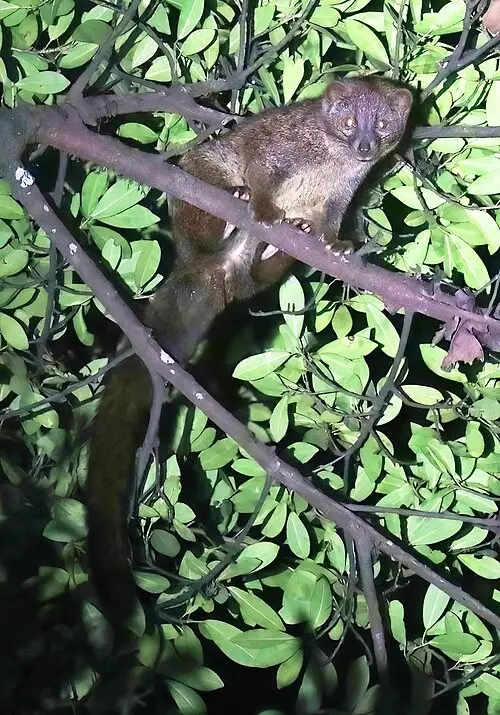
 📸 Photo
Photo: Thomas Galewski · CC BY 4.0 · Wikimedia Commons Source
African Palm Civet
Nandinia binotata (African Palm Civet · キノボリジャコウネコ)
💡 Everyday Comparisons for Size, Mass & Speed
- 💡 A body length of 58 cm is nearly twice the long side of an A4 sheet of paper (29.7 cm) (Comparison).
- 💡 A weight of 5 kg is half of a 10 kg bag of rice (Comparison).
- 💡 In some areas it is hunted for meat and medicine and its fur is used for clothing and hats, while on farms it also acts as a pest controller by catching rodents (ADW).
Reference standards: coach bus ~12 m, mid-size car ~4.9 m, compact car ~1 t, basketball hoop 3.05 m, credit card 8.56 cm.
Site-computed relative index from recorded values; not a formal scientific metric.
📖 1. Overview
The African Palm Civet is a widespread omnivore of equatorial Africa that lives both in trees and on the ground. It is nocturnal and solitary.
🦴 2. Anatomy & Morphology
It measures 42–58 cm in body length and weighs 1.5–5 kg, with males and females looking similar. It moves between the forest canopy and the ground.
🔍 3. Ecology & Behavior
Fruits such as Uapaca, figs, and oil palm pulp are its staple food, and it also eats rodents, insects, lizards, bats, birds, and eggs. It is active for 3–4 hours after sunset and before dawn, and breeds twice a year in the rainy season, giving birth to usually 2 young after about 9 weeks of gestation.
🇰🇷 4. Connection to Korea
No direct record connecting this species to Korea has been found.
📚 Sources & References
- • IUCN Red List LC (2015) — https://www.iucnredlist.org/species/41589/45204645
- • IUCN Red List category LC — latest assessment at iucnredlist.org
- • mammaldiversity.org — 1006027
- • iucnredlist.org — 45204645
- • wikidata.org — Q513081
- • commons.wikimedia.org — File:Nandinia binotata, crop.jpg
- • animaldiversity.org — Nandinia binotata
- • Silhouette: PhyloPic — author not recorded · Public Domain Mark 1.0
Recorded dimensions are widely cited representative estimates from public literature and may vary by study or specimen.