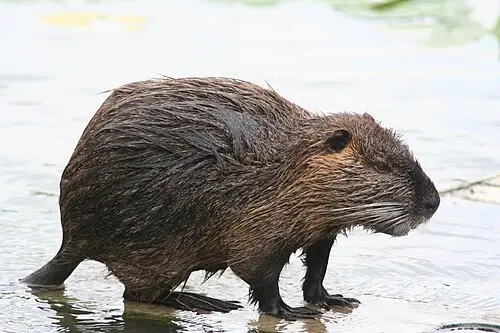
 📸 Photo
Photo: Philippe Amelant · CC BY-SA 3.0 · Wikimedia Commons Source
Coypu
Myocastor coypus (Coypu · ヌートリア)
💡 Everyday Comparisons for Size, Mass & Speed
- 💡 In Korea, it can be seen along watersides in the Nakdong River basin and on Jeju Island.
- 💡 It has been introduced to many parts of the world for its fur and is also eaten for meat.
- 💡 A maximum weight of 10 kg is the same weight as a 10 kg bag of rice (Comparison).
Reference standards: coach bus ~12 m, mid-size car ~4.9 m, compact car ~1 t, basketball hoop 3.05 m, credit card 8.56 cm.
Site-computed relative index from recorded values; not a formal scientific metric.
📖 1. Overview
The Coypu is a large rat-like rodent native to South America that digs burrows along the water's edge.
🦴 2. Anatomy & Morphology
It has a large head, small ears, and a white muzzle tip. Its hind feet are webbed, its incisors are orange, and its tail has sparse long hairs.
🔍 3. Ecology & Behavior
A strong swimmer and diver, it can stay underwater for more than 10 minutes and is most active at night. It eats the leaves and roots of aquatic plants as well as small insects, and gives birth to 5–10 young per litter.
🇰🇷 4. Connection to Korea
According to the National List of Species of Korea, its domestic distribution covers the Nakdong River basin and Jeju Island, where animals introduced for farming became feral.
📚 Sources & References
- • IUCN Red List LC (2016) — https://www.iucnredlist.org/species/14085/121734257
- • IUCN Red List category LC — latest assessment at iucnredlist.org
- • mammaldiversity.org — 1001446
- • iucnredlist.org — 121734257
- • 국가생물종목록(국립생물자원관) ktsn 120000080614 — https://species.nibr.go.kr/home/mainHome.do?cont_link=009&subMenu=009002&contCd=009002&ktsn=120000080614
- • wikidata.org — Q187704
- • commons.wikimedia.org — File:Myocastor coypus - ragondin.jpg
- • species.nibr.go.kr — mainHome.do
- • animaldiversity.org — Myocastor coypus
- • Silhouette: PhyloPic — Mattia Menchetti · CC0 1.0
Recorded dimensions are widely cited representative estimates from public literature and may vary by study or specimen.