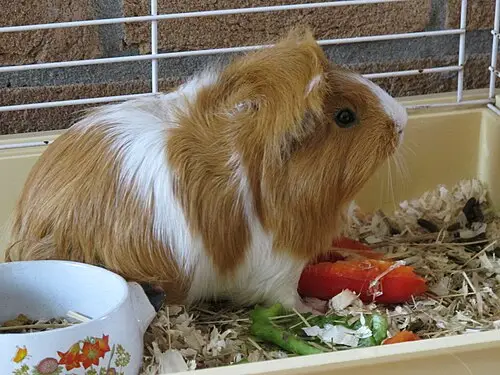
 📸 Photo
Photo: User:Laurita · CC BY 3.0 · Wikimedia Commons Source
Domestic Guinea Pig
Cavia porcellus (Domestic Guinea Pig · モルモット)
Not Evaluated (NE) on the IUCN Red List yet.
💡 Everyday Comparisons for Size, Mass & Speed
- 💡 It is sold worldwide as a pet and is also raised for food in South America.
- 💡 It is used as a laboratory animal in research on scurvy, tuberculosis, juvenile diabetes, and pregnancy complications.
- 💡 Its maximum weight of 1.1 kg is slightly heavier than a 1 L carton of milk (about 1 kg) (Comparison).
Reference standards: coach bus ~12 m, mid-size car ~4.9 m, compact car ~1 t, basketball hoop 3.05 m, credit card 8.56 cm.
Site-computed relative index from recorded values; not a formal scientific metric.
📖 1. Overview
The domestic guinea pig is a tailless rodent that has vanished from the wild and now exists only under human care.
🦴 2. Anatomy & Morphology
It has a small, plump, cylindrical body measuring 20.3–25.4 cm in length and weighing 700–1,100 g. Its 20 teeth grow continuously and are kept at the proper length by grinding against one another.
🔍 3. Ecology & Behavior
Strictly herbivorous, it eats lettuce, cabbage, grasses, and fruits, supplemented with feed pellets for nutrients such as vitamin C. Sociable and active at dusk and dawn, it freezes or scatters when threatened.
🇰🇷 4. Connection to Korea
No direct record connecting this species to Korea has been found.
📚 Sources & References
- • IUCN Red List: not evaluated (NE) — cross-checked with the Wikidata conservation-status entry
- • mammaldiversity.org — 1001195
- • wikidata.org — Q79803
- • commons.wikimedia.org — File:Conill porquí gàbia.JPG
- • animaldiversity.org — Cavia porcellus
- • Silhouette: PhyloPic — Daniel Stadtmauer · CC0 1.0
Recorded dimensions are widely cited representative estimates from public literature and may vary by study or specimen.