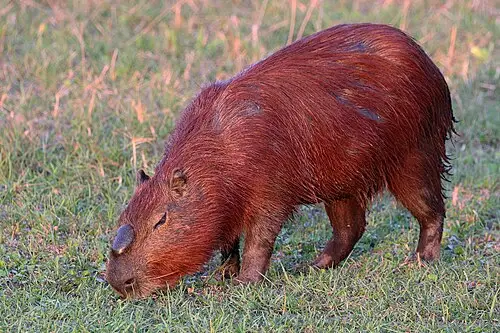
 📸 Photo
Photo: Charles J. Sharp · CC BY-SA 4.0 · Wikimedia Commons Source
Greater Capybara
Hydrochoerus hydrochaeris (Greater Capybara · カピバラ)
💡 Everyday Comparisons for Size, Mass & Speed
- 💡 Its maximum weight of 66 kg is about the weight of an adult human (Comparison).
- 💡 Its shoulder height of 0.6 m is slightly lower than the height of a desk (about 0.7 m) (Comparison).
- 💡 It is hunted for its meat and leather, and during Lent its meat is popular as an alternative to beef or pork.
Reference standards: coach bus ~12 m, mid-size car ~4.9 m, compact car ~1 t, basketball hoop 3.05 m, credit card 8.56 cm.
Site-computed relative index from recorded values; not a formal scientific metric.
📖 1. Overview
The Greater Capybara is the largest rodent, living in groups in South American grasslands and forests near water.
🦴 2. Anatomy & Morphology
It has a sturdy, barrel-shaped body with no tail, and coarse reddish-brown fur. Its feet are partially webbed, and its eyes, ears, and nostrils sit near the top of the head, making it well suited to staying submerged in water.
🔍 3. Ecology & Behavior
It feeds mainly on grasses and aquatic plants, and re-ingests the previous day's food each morning. It usually forms groups of around 10 individuals to defend a territory and breeds year-round, peaking at the start of the rainy season.
🇰🇷 4. Connection to Korea
No direct record connecting this species to Korea has been found.
📚 Sources & References
- • IUCN Red List LC (2016) — https://www.iucnredlist.org/species/10300/22190005
- • IUCN Red List category LC — latest assessment at iucnredlist.org
- • mammaldiversity.org — 1001209
- • iucnredlist.org — 22190005
- • wikidata.org — Q131538
- • commons.wikimedia.org — File:Capybara (Hydrochoerus hydrochaeris) alpha male.JPG
- • animaldiversity.org — Hydrochoerus hydrochaeris
- • Silhouette: PhyloPic — Skye M · CC0 1.0
Recorded dimensions are widely cited representative estimates from public literature and may vary by study or specimen.