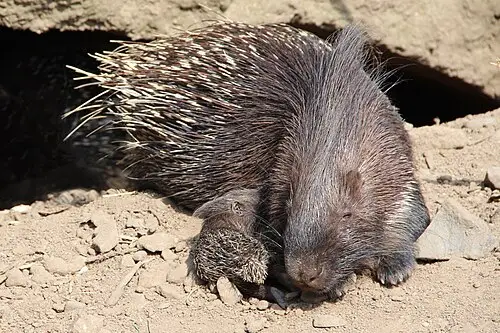
 📸 Photo
Photo: Jean-Pol GRANDMONT · CC BY-SA 3.0 · Wikimedia Commons Source
Crested Porcupine
Hystrix cristata (Crested Porcupine · タテガミヤマアラシ)
💡 Everyday Comparisons for Size, Mass & Speed
- 💡 A single thick quill is about 35 cm long, slightly longer than a 30 cm ruler (Comparison).
- 💡 Its quills are used as ornaments and talismans, and its meat is considered a delicacy, leading to illegal hunting.
- 💡 Its maximum head-and-body length of 93 cm is about the length of a folded long umbrella (about 90 cm) (Comparison).
Reference standards: coach bus ~12 m, mid-size car ~4.9 m, compact car ~1 t, basketball hoop 3.05 m, credit card 8.56 cm.
Site-computed relative index from recorded values; not a formal scientific metric.
📖 1. Overview
The Crested Porcupine is a large rodent with thick quills on its head and back, adapting well to habitats ranging from forests to deserts.
🦴 2. Anatomy & Morphology
Its head, neck, shoulders, limbs, and underside are covered in coarse dark bristles, and the quills on its head, nape, and back can be raised into a crest. Along the sides and rear half of the body are sturdy quills about 350 mm long used for defense, marked with alternating light and dark bands.
🔍 3. Ecology & Behavior
Nocturnal, it eats bark, roots, tubers, fruit, and crops, and occasionally insects or carrion. Monogamous pairs share a large burrow system with their young, and after about 112 days of gestation females give birth to one or two offspring.
🇰🇷 4. Connection to Korea
No direct record connecting this species to Korea has been found.
📚 Sources & References
- • IUCN Red List LC (2016) — https://www.iucnredlist.org/species/10746/22232484
- • IUCN Red List category LC — latest assessment at iucnredlist.org
- • mammaldiversity.org — 1001286
- • iucnredlist.org — 22232484
- • wikidata.org — Q262307
- • commons.wikimedia.org — File:0 Hystrix cristata - Porc-épics à crête (1).JPG
- • animaldiversity.org — Hystrix cristata
- • Silhouette: PhyloPic — Steven Traver · CC0 1.0
Recorded dimensions are widely cited representative estimates from public literature and may vary by study or specimen.