 📸 Photo
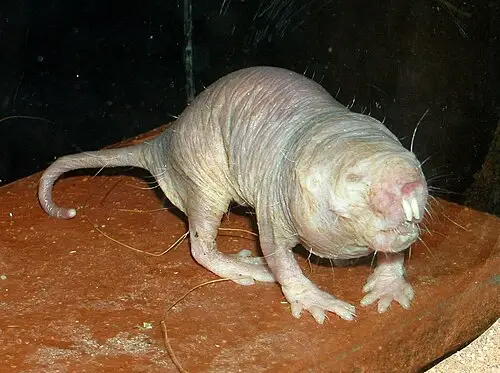
Photo: Roman Klementschitz , Wien · CC BY-SA 3.0 · Wikimedia Commons Source
Common Naked Mole-rat
Heterocephalus glaber (Common Naked Mole-rat · ハダカデバネズミ)
💡 Everyday Comparisons for Size, Mass & Speed
- 💡 Its average weight of 35.3 g is lighter than one chicken egg (about 60 g) (Comparison).
- 💡 Parks and zoos in Kenya protect the Common Naked Mole-rat, making it an ecotourism resource.
- 💡 Its maximum body length of 16.5 cm is just shy of the length of a new pencil (about 17.5 cm) (Comparison).
Reference standards: coach bus ~12 m, mid-size car ~4.9 m, compact car ~1 t, basketball hoop 3.05 m, credit card 8.56 cm.
Site-computed relative index from recorded values; not a formal scientific metric.
📖 1. Overview
The Common Naked Mole-rat is a hairless rodent living in underground burrows in East Africa that forms ant-like colonies centered on a queen.
🦴 2. Anatomy & Morphology
Its wrinkled pinkish-brown skin is nearly hairless except for short sensory hairs. Its tiny eyes have thick eyelids that shut out light, and it navigates by sound and touch.
🔍 3. Ecology & Behavior
Eusocial, only one queen and a few breeding males produce young while non-breeders divide tasks such as caring for pups, carrying food, and digging tunnels. It feeds on and stores underground roots, bulbs, and tubers.
🇰🇷 4. Connection to Korea
No direct record connecting this species to Korea has been found.
📚 Sources & References
- • IUCN Red List LC (2016) — https://www.iucnredlist.org/species/9987/115095455
- • IUCN Red List category LC — latest assessment at iucnredlist.org
- • mammaldiversity.org — 1001280
- • iucnredlist.org — 115095455
- • wikidata.org — Q276290
- • commons.wikimedia.org — File:Nacktmull.jpg
- • animaldiversity.org — Heterocephalus glaber
- • Silhouette: PhyloPic — Andy Wilson · CC0 1.0
Recorded dimensions are widely cited representative estimates from public literature and may vary by study or specimen.