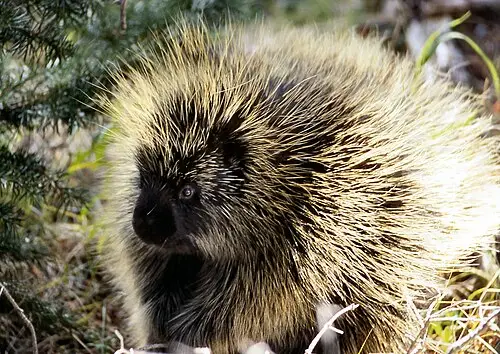
 📸 Photo
Photo: Public domain · Public domain · Wikimedia Commons Source
North American Porcupine
Erethizon dorsatum (North American Porcupine · カナダヤマアラシ)
💡 Everyday Comparisons for Size, Mass & Speed
- 💡 Its quills are not thrown or shot, but come loose when a predator touches them.
- 💡 At the Smithsonian's National Zoo, the North American Porcupine eats herbivore pellets, fruits, and vegetables, and its favorite food is corn on the cob.
- 💡 Its maximum weight of 14 kg is slightly heavier than a 10 kg bag of rice (Comparison).
Reference standards: coach bus ~12 m, mid-size car ~4.9 m, compact car ~1 t, basketball hoop 3.05 m, credit card 8.56 cm.
Site-computed relative index from recorded values; not a formal scientific metric.
📖 1. Overview
The North American Porcupine is the second-largest rodent in North America after the beaver, a stocky, slow-moving animal covered in quills.
🦴 2. Anatomy & Morphology
Its body is dark brown to black overall with yellow bands on its quills. About 30,000 hollow quills measuring 5–7 cm are loosely attached to the skin and detach easily on contact with a predator.
🔍 3. Ecology & Behavior
A mostly solitary generalist herbivore, it eats evergreen needles and inner tree bark in winter and berries, seeds, grasses, leaves, and roots in spring and summer, breeding once a year.
🇰🇷 4. Connection to Korea
No direct record connecting this species to Korea has been found.
📚 Sources & References
- • IUCN Red List LC (2016) — https://www.iucnredlist.org/species/8004
- • IUCN Red List category LC — latest assessment at iucnredlist.org
- • mammaldiversity.org — 1001254
- • iucnredlist.org — 8004
- • wikidata.org — Q10758828
- • commons.wikimedia.org — File:Porcupine NPS11952.jpg
- • animaldiversity.org — Erethizon dorsatum
- • nationalzoo.si.edu — north-american-porcupine
- • Silhouette: PhyloPic — author not recorded · CC0 1.0
Recorded dimensions are widely cited representative estimates from public literature and may vary by study or specimen.