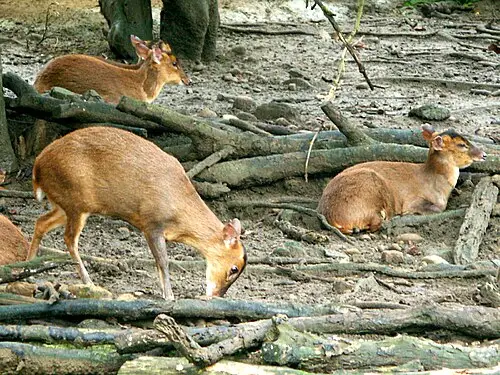
 📸 Photo
Photo: KaurJmeb · CC BY-SA 2.0 · Wikimedia Commons Source
Reeves's Muntjac
Muntiacus reevesi (Reeves's Muntjac · キョン)
💡 Everyday Comparisons for Size, Mass & Speed
- 💡 It is hunted for meat and is also hunted for sport in Britain (Animal Diversity Web).
- 💡 In forests, its barks have helped warn people of nearby tigers or leopards (Animal Diversity Web).
- 💡 A maximum weight of 28 kg is equal to nearly one and a half 20 kg bags of rice (Comparison).
Reference standards: coach bus ~12 m, mid-size car ~4.9 m, compact car ~1 t, basketball hoop 3.05 m, credit card 8.56 cm.
Site-computed relative index from recorded values; not a formal scientific metric.
📖 1. Overview
Reeves's Muntjac is a small forest deer native to China. In Britain and western Europe, released individuals have established wild breeding populations.
🦴 2. Anatomy & Morphology
It has a chestnut coat and a tail that is black on top and white underneath. Males have short antlers measuring 125–150 mm and tusk-like canines measuring 2.5–5 cm.
🔍 3. Ecology & Behavior
It is an omnivore that eats not only bamboo, seeds, bark, and fruit, but also eggs and carrion. Solitary individuals defend territories and fight with their tusks, breeding year-round in their native range.
🇰🇷 4. Connection to Korea
No direct record connecting this species to Korea has been found.
📚 Sources & References
- • IUCN Red List LC (2016) — https://www.iucnredlist.org/species/42191/170905827
- • IUCN Red List category LC — latest assessment at iucnredlist.org
- • mammaldiversity.org — 1006335
- • iucnredlist.org — 170905827
- • wikidata.org — Q695973
- • commons.wikimedia.org — File:Formosan Reeve's muntjac.jpg
- • animaldiversity.org — Muntiacus reevesi
- • Silhouette: PhyloPic — An Ignorant Atheist · CC0 1.0 (Related taxon silhouette — Cervidae)
Recorded dimensions are widely cited representative estimates from public literature and may vary by study or specimen.