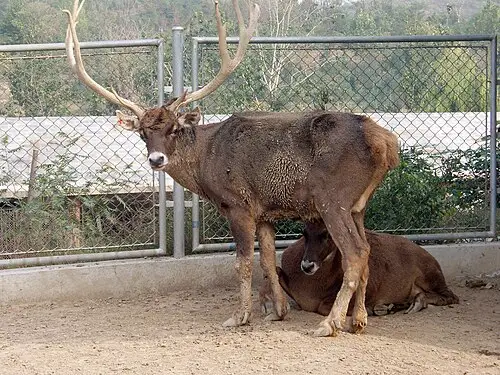
 📸 Photo
Photo: Fanghong · CC BY-SA 3.0 · Wikimedia Commons Source
White-lipped Deer
Cervus albirostris (White-lipped Deer · クチジロジカ)
💡 Everyday Comparisons for Size, Mass & Speed
- 💡 Its antlers and body parts are used in traditional Chinese medicine, and Chinese and Tibetan people have also hunted it for food (Animal Diversity Web).
- 💡 Its antlers weigh up to 7 kg and reach 1.3 m in length, about one-third the weight of a 20 kg bag of rice (Comparison).
- 💡 A body weight of 140 kg is equal to seven 20 kg bags of rice (Comparison).
Reference standards: coach bus ~12 m, mid-size car ~4.9 m, compact car ~1 t, basketball hoop 3.05 m, credit card 8.56 cm.
Site-computed relative index from recorded values; not a formal scientific metric.
📖 1. Overview
The White-lipped Deer is a deer living at high elevations on the Tibetan Plateau in central and western China. Its name comes from the white markings around its mouth and under its throat.
🦴 2. Anatomy & Morphology
The area around the mouth and the underside of the throat are pure white, and its hooves are broad and rounded like those of cattle. The male's antlers are white and branch forward into five to six tines, and the winter coat is twice as long as the summer coat.
🔍 3. Ecology & Behavior
It is an herbivore that mainly eats grasses and sedges such as Stipa, Kobresia, and Carex. Herds segregate by sex and age, and mixed herds of 50 to 300 individuals have been reported during the breeding season.
🇰🇷 4. Connection to Korea
No direct record connecting this species to Korea has been found.
📚 Sources & References
- • IUCN Red List VU (2015) — https://www.iucnredlist.org/species/4256
- • IUCN Red List category VU — latest assessment at iucnredlist.org
- • mammaldiversity.org — 1006311
- • iucnredlist.org — 4256
- • wikidata.org — Q728643
- • commons.wikimedia.org — File:CervusAlbirostris2.jpg
- • animaldiversity.org — Przewalskium albirostris
- • Silhouette: PhyloPic — Steven Traver · CC0 1.0 (Congeneric silhouette — Cervus elaphus)
Recorded dimensions are widely cited representative estimates from public literature and may vary by study or specimen.