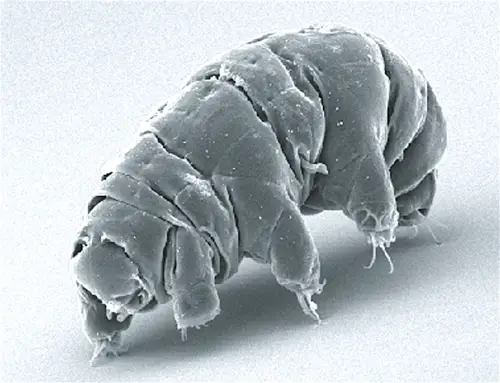
 📸 Photo
Photo: Schokraie E, Warnken U, Hotz-Wagenblatt A, Grohme MA, Hengherr S, et al. (2012) · CC BY 2.5 · Wikimedia Commons Source
Milnesium tardigradum
Milnesium tardigradum (Milnesium tardigradum · オニクマムシ)
Not Evaluated (NE) on the IUCN Red List yet.
💡 Everyday Comparisons for Size, Mass & Speed
- 💡 Because it is most commonly found in moss and lichens on rocks or trees in temperate regions (ADW), it is an animal that can even live on mossy rocks in parks.
- 💡 Its body length of 0.7 mm is the same as the line width drawn by a 0.7 mm ballpoint pen (Comparison).
- 💡 Its ability to withstand extreme conditions such as desiccation and freezing has sparked interest in cell and organ preservation research (ADW).
Reference standards: coach bus ~12 m, mid-size car ~4.9 m, compact car ~1 t, basketball hoop 3.05 m, credit card 8.56 cm.
📖 1. Overview
Milnesium tardigradum is a predatory water bear distributed worldwide and is relatively large among tardigrades.
🦴 2. Anatomy & Morphology
Its body is a plump cylinder with 4 segments behind the head, each bearing a pair of stubby legs with two-branched claws. The mouth connects to a sucking pharynx equipped with calcium stylets.
🔍 3. Ecology & Behavior
It is an omnivorous predator that feeds on rotifers, nematodes, and algae and even preys on smaller water bears, with a record of eating 13 rotifers within 17 minutes. During drought, it expels water from its body and survives in a dormant 'tun' state with halted metabolism.
🇰🇷 4. Connection to Korea
It is listed on the National List of Species of Korea under the name Ttangkong-gombeolle (Korean name).
📚 Sources & References
- • IUCN Red List: not evaluated (NE) — cross-checked with the Wikidata conservation-status entry
- • catalogueoflife.org — 43DJL
- • 국가생물종목록(국립생물자원관) ktsn 120000040049 — https://species.nibr.go.kr/home/mainHome.do?cont_link=009&subMenu=009002&contCd=009002&ktsn=120000040049
- • wikidata.org — Q2396784
- • commons.wikimedia.org — File:SEM image of Milnesium tardigradum in active state - jo
- • animaldiversity.org — Milnesium tardigradum
Recorded dimensions are widely cited representative estimates from public literature and may vary by study or specimen.