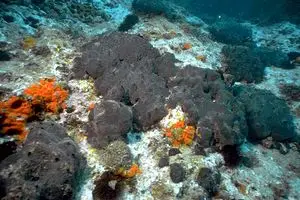
 📸 Photo
Photo: Guido Picchetti - http://www.guidopicchetti.it · CC BY-SA 3.0 · Wikimedia Commons Source
Bath sponge
Spongia officinalis (Bath sponge · モクヨクカイメン)
Not Evaluated (NE) on the IUCN Red List yet.
💡 Everyday Comparisons for Size, Mass & Speed
- 💡 Individuals growing to over 35 cm in diameter are much larger than a soccer ball (diameter about 22 cm) (Comparison).
- 💡 As a fine sponge used for washing, it has high commercial value and is harvested mainly in Greece, though production is low (SeaLifeBase).
Reference standards: coach bus ~12 m, mid-size car ~4.9 m, compact car ~1 t, basketball hoop 3.05 m, credit card 8.56 cm.
📖 1. Overview
The bath sponge is a sponge living attached to rocks in shallow Mediterranean waters. Used as a soft sponge for washing, it is harvested mainly in Greece.
🦴 2. Anatomy & Morphology
Its body is generally massive and rounded, with larger individuals bearing rounded or conical lobes. Its surface has many small conules, and its oscula are 0.3–1 cm in diameter. Its color varies from yellowish-white to black depending on the light.
🔍 3. Ecology & Behavior
It is common under rock overhangs at depths between 5 m and 40 m and rare at 40–76 m. It is a filter feeder that strains food particles from the water.
🇰🇷 4. Connection to Korea
No direct record connecting this species to Korea has been found.
📚 Sources & References
- • IUCN Red List: not evaluated (NE) — cross-checked with the Wikidata conservation-status entry
- • marinespecies.org — aphia.php
- • wikidata.org — Q652237
- • commons.wikimedia.org — File:Spongia officinalis.jpg
- • sealifebase.se — Spongia-officinalis.html
- • Silhouette: PhyloPic — author not recorded · CC0 1.0
Recorded dimensions are widely cited representative estimates from public literature and may vary by study or specimen.