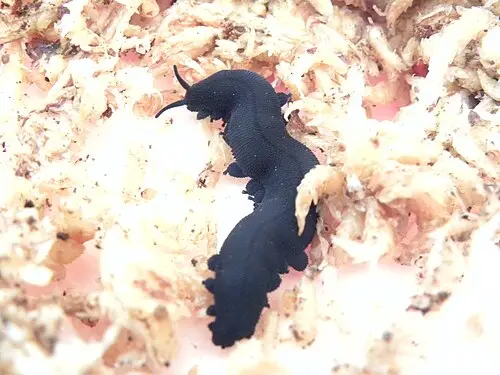
 📸 Photo
Photo: Alan Couch · CC BY 2.0 · Wikimedia Commons Source
Euperipatoides rowelli
Euperipatoides rowelli (Euperipatoides rowelli · Euperipatoides rowelli)
Not Evaluated (NE) on the IUCN Red List yet.
💡 Everyday Comparisons for Size, Mass & Speed
- 💡 Velvet worms commonly seen in Australia measure 2–4 cm, about the length of one thumb joint (about 3 cm).
- 💡 It is a moisture-loving animal that can be found by turning over rotting logs; because it is vulnerable to drying out, it lives only in damp places (Australian Museum).
Reference standards: coach bus ~12 m, mid-size car ~4.9 m, compact car ~1 t, basketball hoop 3.05 m, credit card 8.56 cm.
📖 1. Overview
Euperipatoides rowelli belongs to the family Peripatopsidae, a group of velvet worms living in the Southern Hemisphere. Because species-specific data are not in the reference bundle, the description below covers general traits of velvet worms.
🦴 2. Anatomy & Morphology
The body of velvet worms is covered with a very thin chitin layer, looks velvety due to skin papillae, and repels water. The head has 2 antennae and 2 simple eyes, and Australian species have 14–16 pairs of stubby legs.
🔍 3. Ecology & Behavior
It is a predator that lives inside damp rotting logs and leaf litter, preying on small invertebrates. It squirts sticky slime from oral tubes to entangle prey, then injects digestive saliva and sucks up the liquefied flesh. Young are born looking like miniature adults.
🇰🇷 4. Connection to Korea
No direct record connecting this species to Korea has been found.
📚 Sources & References
- • IUCN Red List: not evaluated (NE) — cross-checked with the Wikidata conservation-status entry
- • catalogueoflife.org — 3CLWZ
- • wikidata.org — Q3601766
- • commons.wikimedia.org — File:Euperipatoides rowelli 2.jpg
- • australian.museum — velvet-worm
- • arxiv.org — 1511.01056
Recorded dimensions are widely cited representative estimates from public literature and may vary by study or specimen.