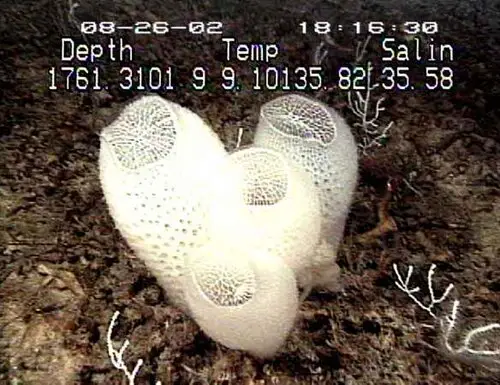
 📸 Photo
Photo: NOAA Office of Ocean Exploration · Public domain · Wikimedia Commons Source
Venus' flower basket
Euplectella aspergillum (Venus' flower basket · カイロウドウケツ)
Not Evaluated (NE) on the IUCN Red List yet.
💡 Everyday Comparisons for Size, Mass & Speed
- 💡 In Japan, because a pair of shrimp inside lives together for life, it was used as a wedding gift symbolizing 'together until death' (NOAA Ocean Exploration).
- 💡 Its strong, lightweight lattice skeleton inspired architect Frei Otto's lightweight structures and is now studied for materials such as bone substitutes (University of Stuttgart Library).
- 💡 Its skeleton length of 25 cm is slightly shorter than the long side of an A4 sheet of paper (29.7 cm).
Reference standards: coach bus ~12 m, mid-size car ~4.9 m, compact car ~1 t, basketball hoop 3.05 m, credit card 8.56 cm.
📖 1. Overview
Venus' flower basket is a glass sponge with a mesh-like skeleton made of silica, living on the deep seafloor near the Philippines.
🦴 2. Anatomy & Morphology
The skeleton is a curved tube about 25 cm long, covered by a thin layer of cells when alive. It attaches to the seafloor with a bundle of fibers at its narrow base, and proteins solidify silica from seawater to build the skeleton.
🔍 3. Ecology & Behavior
It draws water through numerous pores in its body wall to filter out organic debris and tiny organisms. A mated pair of shrimp commonly enters the cavity and lives together inside for life.
🇰🇷 4. Connection to Korea
No direct record connecting this species to Korea has been found.
📚 Sources & References
- • IUCN Red List: not evaluated (NE) — cross-checked with the Wikidata conservation-status entry
- • marinespecies.org — aphia.php
- • wikidata.org — Q1523518
- • commons.wikimedia.org — File:Venus Flower Basket.jpg
- • britannica.com — Venuss-flower-basket
- • oceanexplorer.noaa.gov — okeanos-ex1907-logs-nov11
- • oceanservice.noaa.gov — glass-sponge.html
- • ub.uni-stuttgart.de — glass-sponge
- • Silhouette: PhyloPic — author not recorded · CC0 1.0
Recorded dimensions are widely cited representative estimates from public literature and may vary by study or specimen.