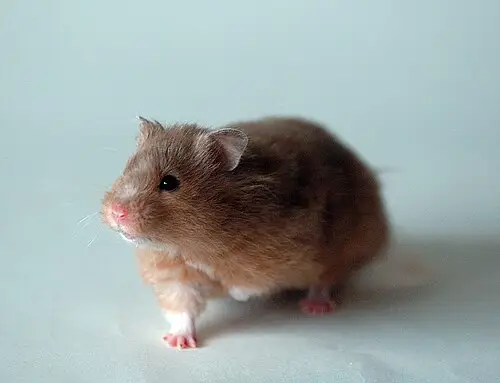
 📸 Photo
Photo: Adamjennison111 at English Wikipedia · CC BY 2.5 · Wikimedia Commons Source
Syrian Golden Hamster
Mesocricetus auratus (Syrian Golden Hamster · ゴールデンハムスター)
💡 Everyday Comparisons for Size, Mass & Speed
- 💡 Its maximum weight of 125 g is about two eggs (about 60 g each), and its length of 13.5 cm is similar to a ballpoint pen (Comparison).
- 💡 The 8 miles it travels in a night is about 12.9 km, close to 1/3 of a marathon distance (42.195 km) (Comparison). Because it breeds rapidly and ovulates regularly, it is used as a laboratory model animal and is a popular pet (Animal Diversity Web).
Reference standards: coach bus ~12 m, mid-size car ~4.9 m, compact car ~1 t, basketball hoop 3.05 m, credit card 8.56 cm.
Site-computed relative index from recorded values; not a formal scientific metric.
📖 1. Overview
The Syrian Golden Hamster is a medium-sized hamster living in dry grasslands and farmland around Syria, and is the most widely known pet hamster.
🦴 2. Anatomy & Morphology
It has a blunt snout, small eyes, large ears, and a short 1.5 cm tail. Its fur is golden brown above and gray or white on the belly.
🔍 3. Ecology & Behavior
Solitary and strongly territorial, it marks its territory with flank scent glands. It rests in its burrow by day and wakes around dusk to gather seeds, nuts, and insects to store in its burrow, sometimes traveling 8 miles (about 13 km) in a single night.
🇰🇷 4. Connection to Korea
No direct record connecting this species to Korea has been found.
📚 Sources & References
- • IUCN Red List EN (2022) — https://www.iucnredlist.org/species/13219/107411865
- • IUCN Red List category EN — latest assessment at iucnredlist.org
- • mammaldiversity.org — 1002208
- • iucnredlist.org — 107411865
- • wikidata.org — Q204175
- • commons.wikimedia.org — File:Golden hamster front 1.jpg
- • animaldiversity.org — Mesocricetus auratus
- • Silhouette: PhyloPic — Edwin Price · CC0 1.0 (Related taxon silhouette — Oligoryzomys nigripes)
Recorded dimensions are widely cited representative estimates from public literature and may vary by study or specimen.