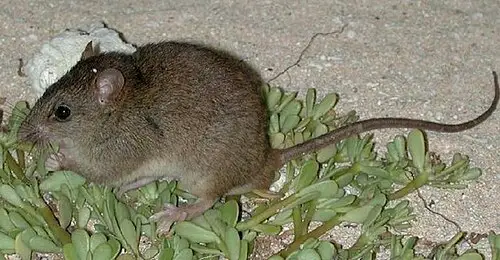
 📸 Photo
Photo: Ian Bell, EHP, State of Queensland · CC BY 3.0 au · Wikimedia Commons Source
Bramble Cay Mosaic-tailed Rat
Melomys rubicola (Bramble Cay Mosaic-tailed Rat · ブランブルケイメロミス)
💡 Everyday Comparisons for Size, Mass & Speed
- 💡 Its maximum body length of 16.5 cm is slightly longer than a mobile phone (about 15 cm) (Comparison). The island area of 4–5 ha where it lived is about five or six soccer fields (about 0.7 ha each) (Comparison).
- 💡 In February (month 2) of 2019, the Australian government moved this species from 'Endangered' to 'Extinct', identifying sea-level rise driven by climate change as the primary cause of its disappearance (Australian Threatened Species Scientific Committee).
Reference standards: coach bus ~12 m, mid-size car ~4.9 m, compact car ~1 t, basketball hoop 3.05 m, credit card 8.56 cm.
📖 1. Overview
The Bramble Cay Mosaic-tailed Rat was a rodent that lived only on a single small coral island in Australia's Torres Strait; in 2019, the Australian government reclassified it as 'Extinct'.
🦴 2. Anatomy & Morphology
The largest of Australia's melomys and about the size of a small rat, it had a rough tail covered in mosaic-like scales. Its fur was reddish-brown with a paler belly, small ears, and a prehensile tail tip.
🔍 3. Ecology & Behavior
Active at night, it rested in burrows or beneath logs. Its diet is poorly known, though it frequently ate portulaca herbs and was also recorded eating turtle eggs. The last record was in 2009, and sea-level rise and storm surges are cited as the most likely causes of its disappearance.
🇰🇷 4. Connection to Korea
No direct record connecting this species to Korea has been found.
📚 Sources & References
- • IUCN Red List EX (2025) — https://www.iucnredlist.org/species/13132/254623401
- • IUCN Red List category EX — latest assessment at iucnredlist.org
- • mammaldiversity.org — 1003223
- • iucnredlist.org — 254623401
- • wikidata.org — Q1760943
- • commons.wikimedia.org — File:Bramble-cay-melomys.jpg
- • environment.gov.au — 64477-listing-advice-22022019.pdf
- • Silhouette: PhyloPic — An Ignorant Atheist · CC0 1.0 (Related taxon silhouette — Muridae)
Recorded dimensions are widely cited representative estimates from public literature and may vary by study or specimen.