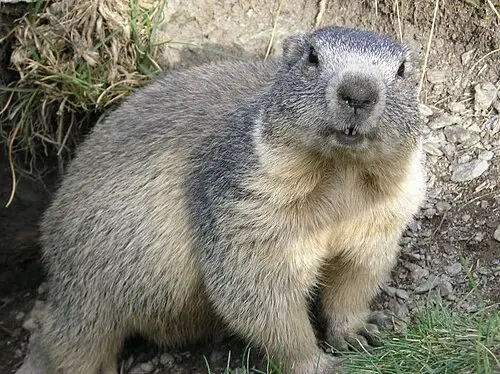
 📸 Photo
Photo: François Trazzi . · CC BY-SA 3.0 · Wikimedia Commons Source
Alpine Marmot
Marmota marmota (Alpine Marmot · アルプスマーモット)
💡 Everyday Comparisons for Size, Mass & Speed
- 💡 Its average weight of 3.5 kg is about 1/3 of a 10 kg bag of rice, and its standing height of 18 cm is slightly taller than a smartphone (about 15 cm) (Comparison).
- 💡 In Germany it is considered a delicacy, and residents of the Alps sometimes use its orange-yellow incisors to decorate belts (Animal Diversity Web).
Reference standards: coach bus ~12 m, mid-size car ~4.9 m, compact car ~1 t, basketball hoop 3.05 m, credit card 8.56 cm.
Site-computed relative index from recorded values; not a formal scientific metric.
📖 1. Overview
The Alpine Marmot is a plump rodent living in cold mountains, digging burrows and living in family groups even where vegetation is sparse.
🦴 2. Anatomy & Morphology
Its coat is a mix of blonde, reddish, and dark gray, and its body is plump and sturdy. Its thumb has a nail instead of a claw while the other toes bear claws, making it well suited for digging.
🔍 3. Ecology & Behavior
It feeds on leaves and blossoms and can eat plants that are poisonous to other mammals. Around 15–20 parents and offspring form a family group, and one individual stands guard, warning the colony with a high whistle when an enemy is spotted.
🇰🇷 4. Connection to Korea
No direct record connecting this species to Korea has been found.
📚 Sources & References
- • IUCN Red List LC (2024) — https://www.iucnredlist.org/species/12835/227283057
- • IUCN Red List category LC — latest assessment at iucnredlist.org
- • mammaldiversity.org — 1001732
- • iucnredlist.org — 227283057
- • wikidata.org — Q285884
- • commons.wikimedia.org — File:Marmota marmota Alpes2.jpg
- • animaldiversity.org — Marmota marmota
- • Silhouette: PhyloPic — T. Michael Keesey · CC0 1.0 (Congeneric silhouette — Marmota monax)
Recorded dimensions are widely cited representative estimates from public literature and may vary by study or specimen.