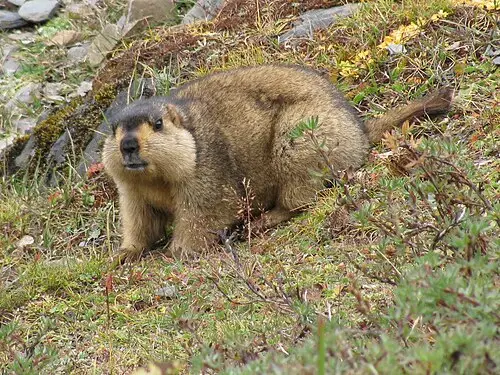
 📸 Photo
Photo: Christopher Fynn · CC BY-SA 3.0 · Wikimedia Commons Source
Himalayan Marmot
Marmota himalayana (Himalayan Marmot · Himalayan Marmot)
💡 Everyday Comparisons for Size, Mass & Speed
- 💡 Animal Diversity Web notes that it is similar in size to an average house cat, and its maximum weight of 9.2 kg is close to a 10 kg bag of rice (Comparison).
- 💡 Its habitat elevation of 5,200 m is nearly twice the height of Baekdusan (2,744 m) (Comparison), and in traditional Tibetan medicine its flesh was reportedly used to treat kidney disease.
Reference standards: coach bus ~12 m, mid-size car ~4.9 m, compact car ~1 t, basketball hoop 3.05 m, credit card 8.56 cm.
Site-computed relative index from recorded values; not a formal scientific metric.
📖 1. Overview
The Himalayan Marmot is a large marmot species living in high meadows at elevations of 3,500–5,200 m.
🦴 2. Anatomy & Morphology
It has a stout body, thick limbs, a short tail, and a relatively large skull. Its forefeet have long, curved claws for digging burrows, and its hindfeet are unusually large.
🔍 3. Ecology & Behavior
Active during the day in the morning and late afternoon, it eats grasses, flowers, roots, seeds, and fruits while avoiding bitter old growth. Where food is plentiful it forms colonies of up to 30 individuals, greeting one another nose-to-nose in the morning.
🇰🇷 4. Connection to Korea
No direct record connecting this species to Korea has been found.
📚 Sources & References
- • IUCN Red List LC (2016) — https://www.iucnredlist.org/species/12826/115106426
- • IUCN Red List category LC — latest assessment at iucnredlist.org
- • mammaldiversity.org — 1001730
- • iucnredlist.org — 115106426
- • wikidata.org — Q922076
- • commons.wikimedia.org — File:Himalayan Marmot at Tshophu Lake Bhutan 091007 b.jpg
- • animaldiversity.org — Marmota himalayana
- • Silhouette: PhyloPic — T. Michael Keesey · CC0 1.0 (Congeneric silhouette — Marmota monax)
Recorded dimensions are widely cited representative estimates from public literature and may vary by study or specimen.