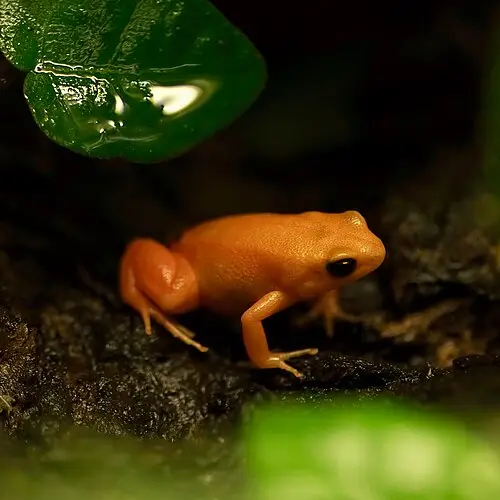
 📸 Photo
Photo: Paul Albertella from Manchester, UK · CC BY 2.0 · Wikimedia Commons Source
Golden Mantella
Mantella aurantiaca (Golden Mantella · Golden Mantella)
💡 Everyday Comparisons for Size, Mass & Speed
- 💡 Its average body length of 3.2 cm is slightly larger than the diameter of a Korean 500-won coin (26.5 mm) (Comparison).
- 💡 Because of its bright coloration, many have been caught from the wild for the pet trade, while some are now bred in captivity (ADW, 'Positive Impacts').
Reference standards: coach bus ~12 m, mid-size car ~4.9 m, compact car ~1 t, basketball hoop 3.05 m, credit card 8.56 cm.
📖 1. Overview
The Golden Mantella is a small, vivid golden-orange frog found only in southeastern Madagascar. It is listed as Endangered (EN, 2020 assessment) on the IUCN Red List.
🦴 2. Anatomy & Morphology
Its snout-to-vent length is usually about 3 cm (1.25 inches), with jet-black eyes and sometimes red flash marks on the inner hind legs. Its legs are very short with adhesive disks on the fingers and toes, and males are smaller and slimmer than females.
🔍 3. Ecology & Behavior
Active during the day, it eats almost any small arthropod, including termites, ants, and fruit flies, and lives in groups on the forest floor. In the wild the ratio of males to females is about 2:1, and courtship takes place secretly under bark, logs, or rocks.
🇰🇷 4. Connection to Korea
No direct record connecting this species to Korea has been found.
📚 Sources & References
- • IUCN Red List EN (2020) — https://www.iucnredlist.org/species/12776/508612
- • IUCN Red List category EN — latest assessment at iucnredlist.org
- • catalogueoflife.org — 736LN
- • iucnredlist.org — 508612
- • wikidata.org — Q775326
- • animaldiversity.org — Mantella aurantiaca
- • Silhouette: PhyloPic — Ferran Sayol · CC0 1.0 (Congeneric silhouette — Mantella milotympanum)
Recorded dimensions are widely cited representative estimates from public literature and may vary by study or specimen.