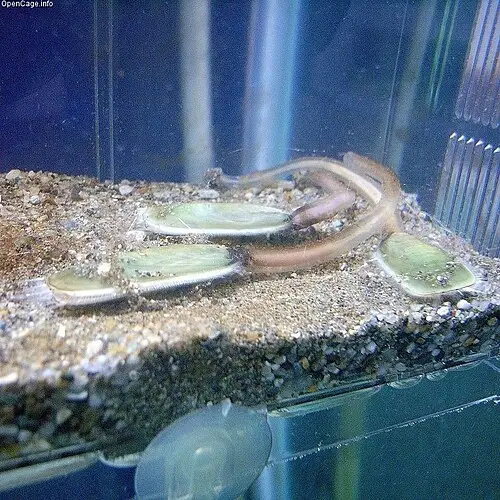
 📸 Photo
Photo: Daiju Azuma · CC BY-SA 2.5 · Wikimedia Commons Source
Lamp shell
Lingula anatina (Lamp shell · ミドリシャミセンガイ)
Not Evaluated (NE) on the IUCN Red List yet.
💡 Everyday Comparisons for Size, Mass & Speed
- 💡 The story of the lamp shell illustrates how large reclamation projects like the Saemangeum seawall dry out the homes of tidal flat organisms (Hong et al. 2007).
- 💡 Although its outer appearance resembles a clam, it belongs to the phylum Brachiopoda (SeaLifeBase), making it a different group from the clams (mollusks) served at the dining table.
Reference standards: coach bus ~12 m, mid-size car ~4.9 m, compact car ~1 t, basketball hoop 3.05 m, credit card 8.56 cm.
📖 1. Overview
The lamp shell looks like a clam, but it is a marine animal belonging to the phylum Brachiopoda that burrows in sandy mud.
🦴 2. Anatomy & Morphology
It is a brachiopod with two shells. A distinctive bivalve that lives attached to lamp shell valves has been reported from the west coast of Korea.
🔍 3. Ecology & Behavior
It is a filter feeder with separate sexes that fertilizes eggs by releasing eggs and sperm into the water. The eggs pass through a swimming larval stage before becoming adults.
🇰🇷 4. Connection to Korea
A 2007 study reported that a bivalve living attached to lamp shells in the Saemangeum tidal flat on the west coast of Korea faced the risk of disappearing as the tidal flat dried out after the seawall was completed in 2006.
📚 Sources & References
- • IUCN Red List: not evaluated (NE) — cross-checked with the Wikidata conservation-status entry
- • marinespecies.org — aphia.php
- • 국가생물종목록(국립생물자원관) ktsn 120000095656 — https://species.nibr.go.kr/home/mainHome.do?cont_link=009&subMenu=009002&contCd=009002&ktsn=120000095656
- • wikidata.org — Q13919752
- • commons.wikimedia.org — File:Lingula anatina.jpg
- • sealifebase.se — Lingula-anatina.html
- • jstage.jst.go.jp — en
- • Silhouette: PhyloPic — Riccardo Percudani · CC0 1.0
Recorded dimensions are widely cited representative estimates from public literature and may vary by study or specimen.