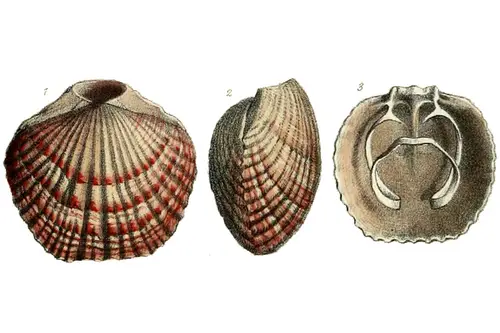
 📸 Photo
Photo: Th.Davidson · Public domain · Wikimedia Commons Source
Coptothyris grayi
Coptothyris grayi (Coptothyris grayi · Coptothyris grayi)
Not Evaluated (NE) on the IUCN Red List yet.
💡 Everyday Comparisons for Size, Mass & Speed
- 💡 Although only about 300 species of lamp shells exist today, they were very common in Paleozoic seas (UCMP).
- 💡 After declining sharply in the end-Permian mass extinction about 250 million years ago, they never flourished to the same extent again (UCMP).
Reference standards: coach bus ~12 m, mid-size car ~4.9 m, compact car ~1 t, basketball hoop 3.05 m, credit card 8.56 cm.
📖 1. Overview
Coptothyris grayi is a brachiopod (lamp shell) that looks like a clam but is not closely related to bivalves. The first recorded holotype came from the Korea Strait, and it is also known from Japanese waters and the East Sea.
🦴 2. Anatomy & Morphology
Lamp shells resemble clams in outer appearance, but their body structure is very different and they are not closely related to mollusks. Like bryozoans and phoronids, they belong to the group possessing a lophophore.
🔍 3. Ecology & Behavior
It is a living marine species. Many lamp shells live in cold waters such as polar regions or the deep sea, so they are rarely noticed, and about 300 species exist today.
🇰🇷 4. Connection to Korea
It is listed as 'Serojuljogaesadon' (Korean name) in the National List of Species of Korea, and the collection locality of the holotype is the Korea Strait (WoRMS).
📚 Sources & References
- • IUCN Red List: not evaluated (NE) — cross-checked with the Wikidata conservation-status entry
- • marinespecies.org — aphia.php
- • 국가생물종목록(국립생물자원관) ktsn 120000039909 — https://species.nibr.go.kr/home/mainHome.do?cont_link=009&subMenu=009002&contCd=009002&ktsn=120000039909
- • wikidata.org — Q2282312
- • commons.wikimedia.org — File:Coptothyris grayi.png
- • ucmp.berkeley.edu — brachiopoda.html
- • Silhouette: PhyloPic — Ludwik Gąsiorowski · CC0 1.0 (Related taxon silhouette — Terebratalia)
Recorded dimensions are widely cited representative estimates from public literature and may vary by study or specimen.