 📸 Photo
Photo: Thomas Quine · CC BY 2.0 · Wikimedia Commons Source
Vicuña
Lama vicugna (Vicuña · Vicuña)
💡 Everyday Comparisons for Size, Mass & Speed
- 💡 Its wool is extremely fine and soft, making it prized for cloth; heavy hunting pushed it to the brink of extinction in the 1960s, but protection allowed numbers to recover.
- 💡 Its average weight of about 45 kg is lighter than a single adult human (Comparison).
Reference standards: coach bus ~12 m, mid-size car ~4.9 m, compact car ~1 t, basketball hoop 3.05 m, credit card 8.56 cm.
Site-computed relative index from recorded values; not a formal scientific metric.
📖 1. Overview
The Vicuña is a wild camelid living on the high plateaus of the Andes, famous for having the finest wool.
🦴 2. Anatomy & Morphology
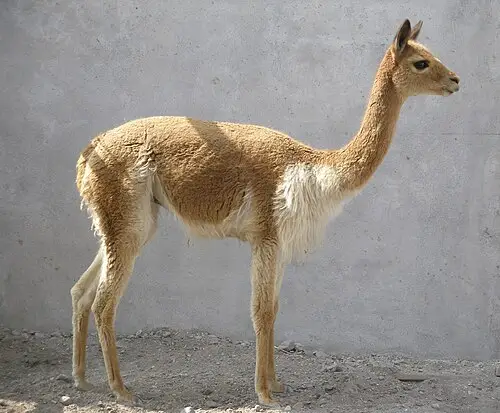
It has a long neck and legs and a slender body. Its coat is pale brown with a whitish belly, and it is smaller than the Llama, Alpaca, and Guanaco.
🔍 3. Ecology & Behavior
Grasses make up 59–72% of its diet and shrubs 16–19%. It lives divided into family groups led by a territorial male, bachelor groups of young males, and solitary old males.
🇰🇷 4. Connection to Korea
No direct record connecting this species to Korea has been found.
📚 Sources & References
- • IUCN Red List LC (2018) — https://www.iucnredlist.org/species/22956/145360542
- • IUCN Red List category LC — latest assessment at iucnredlist.org
- • mammaldiversity.org — 1006388
- • iucnredlist.org — 145360542
- • wikidata.org — Q141570645
- • commons.wikimedia.org — File:Vicuna (89163948) (cropped).jpg
- • animaldiversity.org — Vicugna vicugna
- • Silhouette: PhyloPic — Kai Caspar · CC0 1.0
Recorded dimensions are widely cited representative estimates from public literature and may vary by study or specimen.