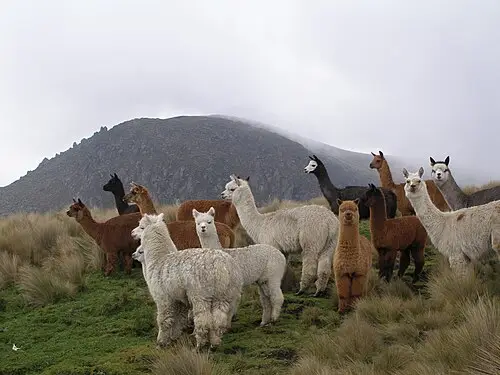
 📸 Photo
Photo: Philippe Lavoie · Public domain · Wikimedia Commons Source
Alpaca
Lama pacos (Alpaca · Alpaca)
Not Evaluated (NE) on the IUCN Red List yet.
💡 Everyday Comparisons for Size, Mass & Speed
- 💡 Its fleece, sheared once a year, is regarded as the finest and is warmer and stronger than sheep's wool; it is used to make cloth and sweaters.
- 💡 Its meat has more protein and less fat than beef or mutton, and its fleece, hide, and dried dung (for fuel and fertilizer) are also used.
- 💡 Its maximum head-and-body length of 2.25 m is about half the length of a passenger car (about 4.5 m) (Comparison).
Reference standards: coach bus ~12 m, mid-size car ~4.9 m, compact car ~1 t, basketball hoop 3.05 m, credit card 8.56 cm.
Site-computed relative index from recorded values; not a formal scientific metric.
📖 1. Overview
The Alpaca is the smallest domesticated camelid species, raised in the Andean highlands for its soft fleece.
🦴 2. Anatomy & Morphology
It has a slender body and neck, long legs, a small head, and large, pointed ears. Its coat comes in solid or multiple colors, and its soft foot pads do not damage pastures.
🔍 3. Ecology & Behavior
A strict grazer that eats only grass, it feeds on Andean highland grasses and cushion plants. It forms herds mixed with llamas, goats, and sheep, living as a domestic animal dependent on humans.
🇰🇷 4. Connection to Korea
No direct record connecting this species to Korea has been found.
📚 Sources & References
- • IUCN Red List: not evaluated (NE) — cross-checked with the Wikidata conservation-status entry
- • mammaldiversity.org — 1006387
- • wikidata.org — Q122181742
- • commons.wikimedia.org — File:Alpacas.JPG
- • animaldiversity.org — Lama pacos
- • nationalzoo.si.edu — alpaca
- • Silhouette: PhyloPic — Ben Murrell · CC0 1.0
Recorded dimensions are widely cited representative estimates from public literature and may vary by study or specimen.