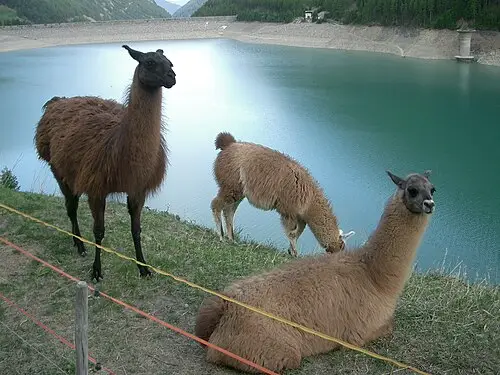
 📸 Photo
Photo: Andrija12345678 · CC BY-SA 4.0 · Wikimedia Commons Source
Llama
Lama glama (Llama · リャマ)
Not Evaluated (NE) on the IUCN Red List yet.
💡 Everyday Comparisons for Size, Mass & Speed
- 💡 Historically, it was used on Andean mountain trails to haul loads of more than 60 kg while walking about 30 km a day.
- 💡 Shearing once every 2 years yields about 3 kg of coarse fleece, and studies show that mixing a few into sheep or goat flocks sharply reduces losses to canids.
- 💡 Its maximum weight of 155 kg equals seven or eight 20 kg bags of rice (Comparison).
Reference standards: coach bus ~12 m, mid-size car ~4.9 m, compact car ~1 t, basketball hoop 3.05 m, credit card 8.56 cm.
Site-computed relative index from recorded values; not a formal scientific metric.
📖 1. Overview
The Llama is the largest of the South American camelids, a domestic animal raised in the Andean highlands to carry loads and provide wool.
🦴 2. Anatomy & Morphology
Hump-free with a long neck and legs, it has a rounded muzzle and a cleft upper lip. Its long, shaggy coat varies widely in color, and each foot has two toes with thick, leathery pads.
🔍 3. Ecology & Behavior
A ruminant with a three-chambered stomach, it browses on low shrubs, lichens, and mountain grasses. About six breeding females and their young form a group led by a single male, and males wrestle for dominance by wrapping their necks and biting.
🇰🇷 4. Connection to Korea
No direct record connecting this species to Korea has been found.
📚 Sources & References
- • IUCN Red List: not evaluated (NE) — cross-checked with the Wikidata conservation-status entry
- • mammaldiversity.org — 1006385
- • wikidata.org — Q42569
- • commons.wikimedia.org — File:Llamas, Vernagt-Stausee, Italy.jpg
- • animaldiversity.org — Lama glama
- • Silhouette: PhyloPic — author not recorded · CC0 1.0
Recorded dimensions are widely cited representative estimates from public literature and may vary by study or specimen.