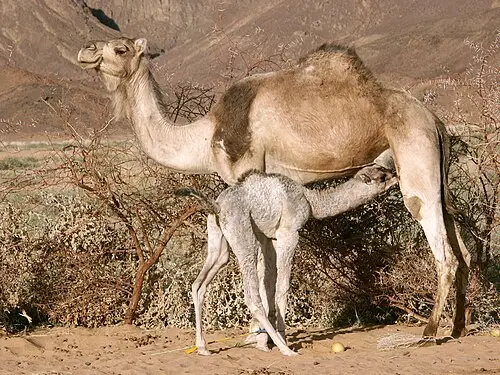
 📸 Photo
Photo: Garrondo · CC BY-SA 3.0 · Wikimedia Commons Source
Dromedary Camel
Camelus dromedarius (Dromedary Camel · ヒトコブラクダ)
Not Evaluated (NE) on the IUCN Red List yet.
💡 Everyday Comparisons for Size, Mass & Speed
- 💡 Its maximum weight of 690 kg is just over thirty 20 kg bags of rice (Comparison).
- 💡 Used to carry loads, it also provides milk, meat, wool, and leather, while its dried dung serves as fuel, enabling humans to live in arid regions.
Reference standards: coach bus ~12 m, mid-size car ~4.9 m, compact car ~1 t, basketball hoop 3.05 m, credit card 8.56 cm.
Site-computed relative index from recorded values; not a formal scientific metric.
📖 1. Overview
The dromedary camel is a camel with only a single hump on its back, long raised in dry deserts as a beast of burden and a source of milk and meat.
🦴 2. Anatomy & Morphology
It has a long, curved neck and a narrow, deep chest. Its hump is a mound of fat that serves as an energy reserve when food is scarce, shrinking and leaning to one side during starvation. Thick lips allow it to eat even thorny plants.
🔍 3. Ecology & Behavior
It feeds mainly on thorny plants, dry grasses, and saltbush, spending 8–12 hours a day grazing and ruminating. One male, several females, and young form a family unit, usually living in groups of 2–20 individuals.
🇰🇷 4. Connection to Korea
No direct record connecting this species to Korea has been found.
📚 Sources & References
- • IUCN Red List: not evaluated (NE) — cross-checked with the Wikidata conservation-status entry
- • mammaldiversity.org — 1006383
- • wikidata.org — Q71516
- • commons.wikimedia.org — File:Camelcalf-feeding.jpg
- • animaldiversity.org — Camelus dromedarius
- • Silhouette: PhyloPic — Katy Lawler · CC0 1.0
Recorded dimensions are widely cited representative estimates from public literature and may vary by study or specimen.