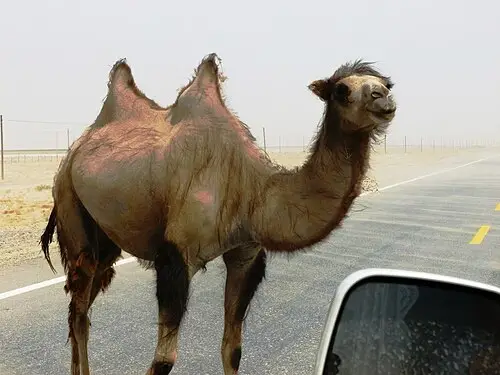
 📸 Photo
Photo: John Hill · CC BY-SA 3.0 · Wikimedia Commons Source
Wild Bactrian Camel
Camelus ferus (Wild Bactrian Camel · フタコブラクダ)
💡 Everyday Comparisons for Size, Mass & Speed
- 💡 Its maximum weight of 690 kg is just over thirty 20 kg bags of rice (Comparison, value for Bactrian camels overall).
- 💡 Domesticated Bactrian camels are used to carry loads across deserts and provide milk (fermented into kumis), meat, and leather, while their hair is made into clothing, blankets, and tents and their dried dung serves as fuel.
Reference standards: coach bus ~12 m, mid-size car ~4.9 m, compact car ~1 t, basketball hoop 3.05 m, credit card 8.56 cm.
Site-computed relative index from recorded values; not a formal scientific metric.
📖 1. Overview
The wild Bactrian camel is a wild two-humped camel remaining in the deserts of Central Asia, now surviving only in remote parts of Mongolia and western China.
🦴 2. Anatomy & Morphology
It has two humps on its back. Although commonly thought to hold water, they actually store fat, serving as an energy reserve in place of food and water. When well nourished, the humps stand upright and plump.
🔍 3. Ecology & Behavior
It eats even salty, thorny, and bitter desert plants, digging through snow for food in winter and moving to the steppe zones of the Gobi Desert. When food is scarce, it is even known to chew bones, hides, and cloth.
🇰🇷 4. Connection to Korea
No direct record connecting this species to Korea has been found.
📚 Sources & References
- • IUCN Red List EN (2025) — https://www.iucnredlist.org/species/63543
- • IUCN Red List category EN — latest assessment at iucnredlist.org
- • mammaldiversity.org — 1006384
- • iucnredlist.org — 63543
- • wikidata.org — Q3030198
- • commons.wikimedia.org — File:Wild Bactrian camel on road east of Yarkand.jpg
- • animaldiversity.org — Camelus bactrianus
- • Silhouette: PhyloPic — Katy Lawler · CC0 1.0 (Congeneric silhouette — Camelus dromedarius)
Recorded dimensions are widely cited representative estimates from public literature and may vary by study or specimen.