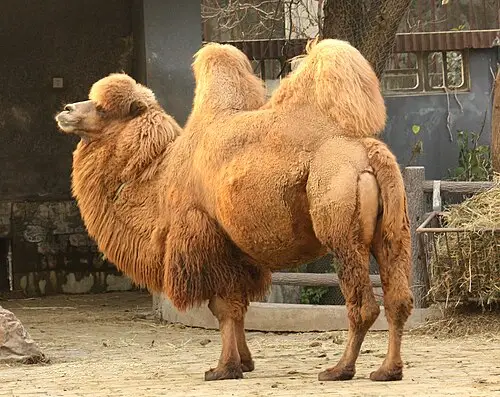
 📸 Photo
Photo: J. Patrick Fischer · CC BY-SA 3.0 · Wikimedia Commons Source
Domestic Bactrian Camel
Camelus bactrianus (Domestic Bactrian Camel · フタコブラクダ)
Not Evaluated (NE) on the IUCN Red List yet.
💡 Everyday Comparisons for Size, Mass & Speed
- 💡 It has been used for desert transport for about 3,500 years; its milk is fermented into a drink called kumis, and its hair is made into clothing, blankets, and tents.
- 💡 Its maximum shoulder height of 2.3 m is similar to the ceiling height of a typical home (about 2.3–2.4 m) (Comparison).
- 💡 Fat from its humps is melted down and used in cooking.
Reference standards: coach bus ~12 m, mid-size car ~4.9 m, compact car ~1 t, basketball hoop 3.05 m, credit card 8.56 cm.
Site-computed relative index from recorded values; not a formal scientific metric.
📖 1. Overview
The domestic Bactrian camel is a two-humped camel that humans have long used to carry loads along desert routes.
🦴 2. Anatomy & Morphology
Its humps store fat rather than water, while a double row of eyelashes and closable nostrils keep out blowing sand. It can survive losing 40% of its body weight and drink up to 57 L of water at a time.
🔍 3. Ecology & Behavior
It feeds on salty desert plants and grasses. Mating in March–April, females gestate for nearly 1 year before giving birth to a single calf.
🇰🇷 4. Connection to Korea
No direct record connecting this species to Korea has been found.
📚 Sources & References
- • IUCN Red List: not evaluated (NE) — cross-checked with the Wikidata conservation-status entry
- • mammaldiversity.org — 1006382
- • wikidata.org — Q132922
- • commons.wikimedia.org — File:2011 Trampeltier 1528.JPG
- • animaldiversity.org — Camelus bactrianus
- • Silhouette: PhyloPic — An Ignorant Atheist · CC0 1.0
Recorded dimensions are widely cited representative estimates from public literature and may vary by study or specimen.