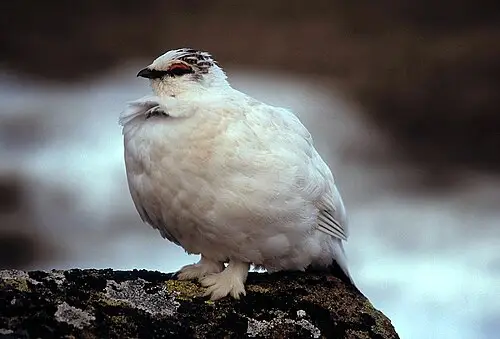
 📸 Photo
Photo: Tim Bowman · Public domain · Wikimedia Commons Source
Rock Ptarmigan
Lagopus muta (Rock Ptarmigan · ライチョウ)
💡 Everyday Comparisons for Size, Mass & Speed
- 💡 Its maximum body length of about 41 cm is about a handspan longer than the long side of an A4 sheet of paper (about 30 cm) (Comparison).
- 💡 Males keep their white plumage longer in spring as part of their courtship display, which also makes them more heavily preyed upon by Gyrfalcons (ADW physical description).
- 💡 In the Alaskan hinterlands, it is hunted with shotguns or snared as a game bird that provides both food and recreation (ADW "Economic Importance for Humans: Positive").
Reference standards: coach bus ~12 m, mid-size car ~4.9 m, compact car ~1 t, basketball hoop 3.05 m, credit card 8.56 cm.
📖 1. Overview
The Rock Ptarmigan is a bird resembling a small grouse or pheasant that lives in tundra and high mountains. In winter, it molts into pure white plumage except for its tail.
🦴 2. Anatomy & Morphology
In winter its entire body is pure white except for its black tail, while in summer it is barred with brown and black. Males have a black stripe from the beak to the eye and a scarlet comb above the eye, while females are more coarsely marked.
🔍 3. Ecology & Behavior
Adults are almost exclusively vegetarian, eating blueberries, horsetails, crowberries, and sedges in summer and buds and catkins of dwarf birch and willow in winter, while chicks feed heavily on insects, spiders, and snails. The female alone incubates 7–10 eggs in a ground nest for about 21 days.
🇰🇷 4. Connection to Korea
No direct record connecting this species to Korea has been found.
📚 Sources & References
- • IUCN Red List LC (2025) — https://www.iucnredlist.org/species/22679464/281852120
- • IUCN Red List category LC — latest assessment at iucnredlist.org
- • doi.org — avilist.v2026
- • iucnredlist.org — 281852120
- • wikidata.org — Q205930
- • commons.wikimedia.org — File:Lagopus muta2.jpg
- • animaldiversity.org — Lagopus muta
- • Silhouette: PhyloPic — author not recorded · Public Domain Mark 1.0 (Congeneric silhouette — Lagopus lagopus)
Recorded dimensions are widely cited representative estimates from public literature and may vary by study or specimen.