 📸 Photo
Photo: oli23000 · CC BY 2.0 · Wikimedia Commons Source
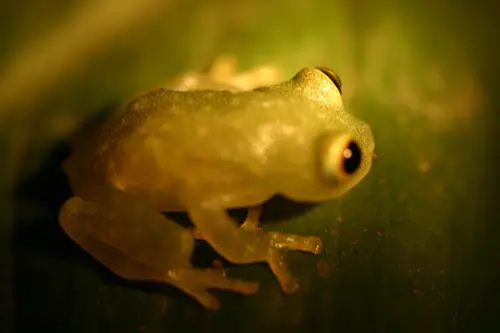
Fleischmann's Glass Frog
Hyalinobatrachium fleischmanni (Fleischmann's Glass Frog · Fleischmann's Glass Frog)
💡 Everyday Comparisons for Size, Mass & Speed
- 💡 A single clutch averages 18–30 eggs, close to a standard tray of eggs (30 eggs) in Korea (Comparison).
- 💡 ADW notes under 'Positive Impacts' that it plays an insect-eating role in forests and is fascinating to study as well as aesthetically valuable to humans.
Reference standards: coach bus ~12 m, mid-size car ~4.9 m, compact car ~1 t, basketball hoop 3.05 m, credit card 8.56 cm.
📖 1. Overview
Fleischmann's Glass Frog is a small frog with transparent belly skin through which its heart and internal organs are visible, living onwaterside leaves in humid montane forests. It is listed as Least Concern (LC, 2022 assessment) on the IUCN Red List.
🦴 2. Anatomy & Morphology
Through the transparent skin covering its belly, organs such as the beating heart and lung coverings can be seen, while the back is pale lime green with tiny scattered black and yellow spots. It has a white vocal sac, gold irises, a very short snout, and fingers that are about half webbed.
🔍 3. Ecology & Behavior
It breeds mainly during the rainy season from May to October, when males hang upside down from the undersides of leaves overhanging water to call and defend territories. Eggs are attached to the underside of leaves and guarded by the male, though about 80% of clutches are estimated to disappear before hatching.
🇰🇷 4. Connection to Korea
No direct record connecting this species to Korea has been found.
📚 Sources & References
- • IUCN Red List LC (2022) — https://www.iucnredlist.org/species/200998956/200999079
- • IUCN Red List category LC — latest assessment at iucnredlist.org
- • catalogueoflife.org — 3MVZN
- • iucnredlist.org — 200999079
- • wikidata.org — Q612124
- • commons.wikimedia.org — File:Hyalinobatrachium fleischmanni.jpg
- • animaldiversity.org — Hyalinobatrachium fleischmanni
- • Silhouette: PhyloPic — Jose Carlos Arenas-Monroy · CC0 1.0 (Congeneric silhouette — Hyalinobatrachium viridissimum)
Recorded dimensions are widely cited representative estimates from public literature and may vary by study or specimen.