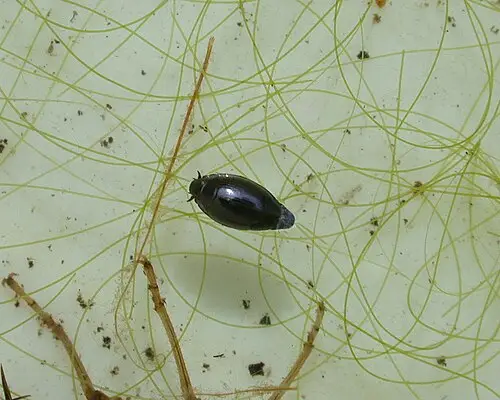
 📸 Photo
Photo: No machine-readable author provided. Keisotyo assumed (based on copyright claims). · CC BY-SA 3.0 · Wikimedia Commons Source
Gyrinus japonicus
Gyrinus japonicus (Gyrinus japonicus · Gyrinus japonicus)
Not Evaluated (NE) on the IUCN Red List yet.
💡 Everyday Comparisons for Size, Mass & Speed
- 💡 Its body length of 10 mm is slightly more than half a Korean 10-won coin (diameter 18 mm) (Comparison).
- 💡 Because the National List of Species of Korea notes that it lives in places with almost no current such as rice paddies and wetlands, it can be encountered in rural rice paddies.
Reference standards: coach bus ~12 m, mid-size car ~4.9 m, compact car ~1 t, basketball hoop 3.05 m, credit card 8.56 cm.
📖 1. Overview
Gyrinus japonicus is a small beetle living on the water surface of rice paddies and wetlands, distributed nationwide in Korea and also living in Japan and China.
🦴 2. Anatomy & Morphology
Its oval body is 8–10 mm long and black, with 11 rows of punctures on its elytra. Its compound eyes are divided into an upper and lower pair, allowing it to see above and below the water surface at the same time.
🔍 3. Ecology & Behavior
It lives in still waters with almost no current, such as wetlands and rice paddies, or among waterside vegetation, where it preys on other aquatic insects.
🇰🇷 4. Connection to Korea
The National List of Species of Korea records its distribution nationwide.
📚 Sources & References
- • IUCN Red List: not evaluated (NE) — cross-checked with the Wikidata conservation-status entry
- • checklistbank.org — P64QJ
- • 국가생물종목록(국립생물자원관) ktsn 120000017497 — https://species.nibr.go.kr/home/mainHome.do?cont_link=009&subMenu=009002&contCd=009002&ktsn=120000017497
- • wikidata.org — Q1862198
- • commons.wikimedia.org — File:Gyrinus japonicus mizusumasi.JPG
- • species.nibr.go.kr — mainHome.do
- • genebank.rda.go.kr — insectView.bo
- • Silhouette: PhyloPic — Desmond W. Helmore · CC BY 4.0 (Congeneric silhouette — Gyrinus convexiusculus)
Recorded dimensions are widely cited representative estimates from public literature and may vary by study or specimen.