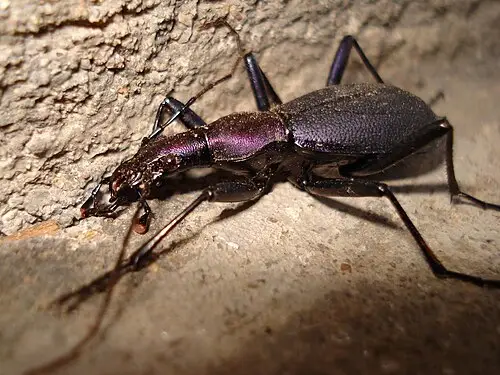
 📸 Photo
Photo: Adan · CC BY-SA 3.0 · Wikimedia Commons Source
Snail-eating beetle
Carabus blaptoides (Snail-eating beetle · マイマイカブリ)
Not Evaluated (NE) on the IUCN Red List yet.
💡 Everyday Comparisons for Size, Mass & Speed
- 💡 Having a body length exceeding 30 mm means it is longer than a Korean 500-won coin (diameter 26.5 mm) (Comparison; the paper gives only a lower bound).
- 💡 A ZooKeys paper explains that this beetle has large mandibles that allow it to easily crush the shells of small snails.
Reference standards: coach bus ~12 m, mid-size car ~4.9 m, compact car ~1 t, basketball hoop 3.05 m, credit card 8.56 cm.
📖 1. Overview
The snail-eating beetle is a ground beetle in the family Carabidae endemic to the Japanese archipelago that feeds on land snails at every growth stage. There are 7 subspecies within Japan.
🦴 2. Anatomy & Morphology
It is a large flightless beetle lacking hindwings, and a ZooKeys paper notes that its body length exceeds 30 mm. There are forms with a wide, short head and thorax and forms with a narrow, elongated head and thorax: the short form crushes the shells of small snails, while the elongated form inserts its head into the shell to eat the body.
🔍 3. Ecology & Behavior
From larva to adult, it eats land snails. In areas with small snails, the short-headed shell-crushing form appears, whereas in areas with large snails, the long-headed shell-inserting form appears, giving the beetle different body shapes across regions.
🇰🇷 4. Connection to Korea
No direct record connecting this species to Korea has been found.
📚 Sources & References
- • IUCN Red List: not evaluated (NE) — cross-checked with the Wikidata conservation-status entry
- • catalogueoflife.org — 5WYSB
- • wikidata.org — Q5037383
- • commons.wikimedia.org — File:Damaster blaptoides 2.JPG
- • pmc.ncbi.nlm.nih.gov — PMC3522234
- • zookeys.pensoft.net — article preview.php
- • Silhouette: PhyloPic — Georgiy Jacobson · Public Domain Mark 1.0 (Congeneric silhouette — Carabus cancellatus)
Recorded dimensions are widely cited representative estimates from public literature and may vary by study or specimen.