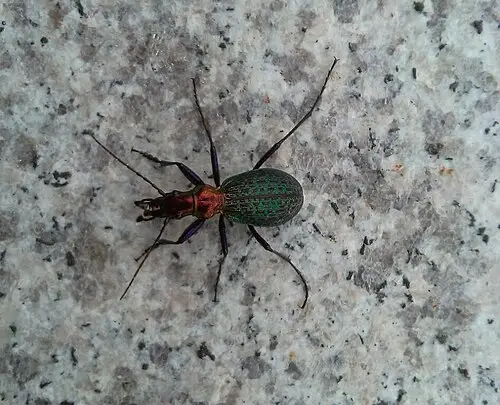
 📸 Photo
Photo: Sjlee236 · CC BY-SA 3.0 · Wikimedia Commons Source
Carabus mirabilissimus
Carabus mirabilissimus (Carabus mirabilissimus · オオズクビナガオサムシ)
Not Evaluated (NE) on the IUCN Red List yet.
🇰🇷 Class II endangered wildlife (Korea) (subspecies Acoptolabrus mirabilissimus mirabilissimus)
💡 Everyday Comparisons for Size, Mass & Speed
- 💡 Its maximum body length of 28 mm is almost equal to the diameter of a Korean 500-won coin (26.5 mm) (Comparison).
- 💡 Because of the fine colors of its elytra, illegal collecting has reduced its numbers. Different mountains have their own subspecies, which are named after the mountains where they live.
Reference standards: coach bus ~12 m, mid-size car ~4.9 m, compact car ~1 t, basketball hoop 3.05 m, credit card 8.56 cm.
📖 1. Overview
Carabus mirabilissimus is a beetle rarely found in mountain old-growth forests at elevations of 900 m or higher, and it is an endemic species found only in Korea. It is a Class II endangered wildlife (Korea).
🦴 2. Anatomy & Morphology
It has a striking body with a dark blue or bluish-green sheen over a black background. Its head is large, its mandibles are strong, and its hindwings are reduced so it cannot fly.
🔍 3. Ecology & Behavior
Both larvae and adults are active at night, preying on invertebrates such as earthworms and snails as well as larvae of small insects. Overwintered adults appear from May, and new adults emerge from mid-July to September.
🇰🇷 4. Connection to Korea
It is a Class II endangered wildlife (Korea) (listed at the subspecies level on the National List of Species of Korea). Distinct subspecies occur on Taebaeksan, Deogyusan, Odaesan, and Irwolsan, and it lives only in parts of Gyeonggi-do, Gangwon-do, Jeollabuk-do, and Gyeongsangbuk-do.
📚 Sources & References
- • 멸종위기 야생생물 Ⅱ급 (아종 Acoptolabrus mirabilissimus mirabilissimus) — 국가생물종목록(국립생물자원관) ktsn 120000014255 — https://species.nibr.go.kr/home/mainHome.do?cont_link=009&subMenu=009002&contCd=009002&ktsn=120000014255
- • IUCN Red List: not evaluated (NE) — cross-checked with the Wikidata conservation-status entry
- • Korean protection status: Class II endangered wildlife (Korea) (subspecies Acoptolabrus mirabilissimus mirabilissimus)
- • catalogueoflife.org — 68YPS
- • 국가생물종목록(국립생물자원관) ktsn 120000014255 — https://species.nibr.go.kr/home/mainHome.do?cont_link=009&subMenu=009002&contCd=009002&ktsn=120000014255
- • wikidata.org — Q12595038
- • commons.wikimedia.org — File:멋조롱박딱정벌레 평창휴양림 2013-05-14.jpg
- • nie.re.kr — view.do
- • bok.or.kr — contents.do
- • Silhouette: PhyloPic — Georgiy Jacobson · Public Domain Mark 1.0 (Congeneric silhouette — Carabus cancellatus)
Recorded dimensions are widely cited representative estimates from public literature and may vary by study or specimen.