 📸 Photo
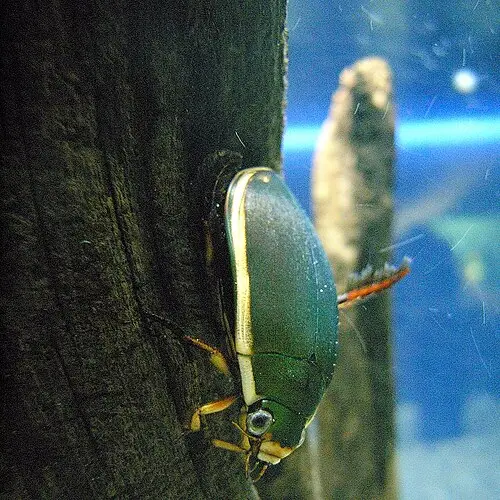
Photo: Daiju Azuma · CC BY-SA 2.5 · Wikimedia Commons Source
Golden edge diving beetle
Cybister chinensis (Golden edge diving beetle · ゲンゴロウ)
Not Evaluated (NE) on the IUCN Red List yet.
🇰🇷 Class II endangered wildlife (Korea)
💡 Everyday Comparisons for Size, Mass & Speed
- 💡 Its maximum body length of 40 mm is about 1.5 times the diameter of a Korean 500-won coin (26.5 mm) (Comparison).
- 💡 Because it is an aquatic insect of rice paddies, ponds, and ditches, heavy pesticide use in rice paddies can easily cause it to disappear. At night, it also flies toward lights.
Reference standards: coach bus ~12 m, mid-size car ~4.9 m, compact car ~1 t, basketball hoop 3.05 m, credit card 8.56 cm.
📖 1. Overview
The golden edge diving beetle is a carnivorous aquatic insect living in plant-rich waters such as rice paddies, ponds, and marshes, and is a Class II endangered wildlife (Korea).
🦴 2. Anatomy & Morphology
It has an elongated oval body 35–40 mm long with a greenish-black back and yellow stripes along the margins of the pronotum and elytra. Males have suction cups on their foreleg tarsi, and the beetle breathes by storing an air bubble at the tip of its elytra.
🔍 3. Ecology & Behavior
Both adults and larvae are carnivorous, feeding on tadpoles, fish, small aquatic organisms, and dead animal carcasses. It lays eggs one by one inside submerged plant stems; adults can be seen year-round and fly toward lights at night.
🇰🇷 4. Connection to Korea
It is a Class II endangered wildlife (Korea). In the past it lived widely across the Korean Peninsula, but pesticide use and environmental pollution have reduced its numbers, making it hard to spot today.
📚 Sources & References
- • 멸종위기 야생생물 Ⅱ급 — 국가생물종목록(국립생물자원관) ktsn 120000017015 — https://species.nibr.go.kr/home/mainHome.do?cont_link=009&subMenu=009002&contCd=009002&ktsn=120000017015
- • IUCN Red List: not evaluated (NE) — cross-checked with the Wikidata conservation-status entry
- • Korean protection status: Class II endangered wildlife (Korea)
- • catalogueoflife.org — 6BT72
- • 국가생물종목록(국립생물자원관) ktsn 120000017015 — https://species.nibr.go.kr/home/mainHome.do?cont_link=009&subMenu=009002&contCd=009002&ktsn=120000017015
- • wikidata.org — Q3140500
- • commons.wikimedia.org — File:Predaceous diving beetle.jpg
- • nie.re.kr — view.do
- • bok.or.kr — contents.do
- • Silhouette: PhyloPic — author not recorded · CC0 1.0 (Congeneric silhouette — Cybister fimbriolatus)
Recorded dimensions are widely cited representative estimates from public literature and may vary by study or specimen.