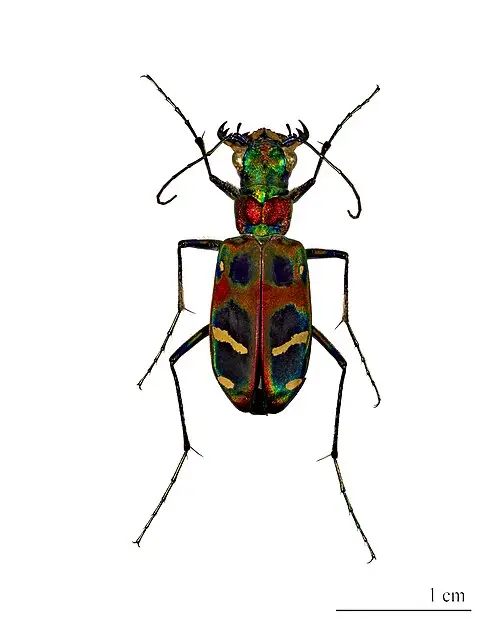
 📸 Photo
Photo: Didier Descouens · CC BY-SA 3.0 · Wikimedia Commons Source
Chinese tiger beetle
Cicindela chinensis (Chinese tiger beetle · Chinese tiger beetle)
Not Evaluated (NE) on the IUCN Red List yet.
💡 Everyday Comparisons for Size, Mass & Speed
- 💡 Its body length of about 20 mm is slightly smaller than a Korean 100-won coin (diameter 24 mm) (Comparison).
- 💡 When a person walks along a mountain path, it flies ahead and lands as if guiding the way, though the National List of Species of Korea explains that it is actually fleeing in alarm.
Reference standards: coach bus ~12 m, mid-size car ~4.9 m, compact car ~1 t, basketball hoop 3.05 m, credit card 8.56 cm.
📖 1. Overview
The Chinese tiger beetle is a carnivorous beetle commonly seen along bare mountain paths and around farm fields, living in inland Korea as well as Japan and China.
🦴 2. Anatomy & Morphology
Its compound eyes and mandibles are well developed and sharp, its long legs make it a fast walker, and its well-developed hindwings make it a strong flier. Its body is around 20 mm long with a green or red metallic sheen, and its elytra have multicolored transverse bands.
🔍 3. Ecology & Behavior
Active during the day, it hunts small insects such as flies, ants, and rove beetles that often land along paths. It has 1 generation per year from August to the following June, and its larva digs a vertical burrow in the ground and catches insects passing by the entrance.
🇰🇷 4. Connection to Korea
The National List of Species of Korea records its distribution in inland regions of the Korean Peninsula.
📚 Sources & References
- • IUCN Red List: not evaluated (NE) — cross-checked with the Wikidata conservation-status entry
- • catalogueoflife.org — V8GQ
- • 국가생물종목록(국립생물자원관) ktsn 120000014547 — https://species.nibr.go.kr/home/mainHome.do?cont_link=009&subMenu=009002&contCd=009002&ktsn=120000014547
- • wikidata.org — Q277237
- • commons.wikimedia.org — File:Cicindela chinensis flammifera MHNT.ZOO.2004.0.175.jpg
- • genebank.rda.go.kr — insectView.bo
- • species.nibr.go.kr — mainHome.do
- • Silhouette: PhyloPic — Georgiy Jacobson · Public Domain Mark 1.0 (Congeneric silhouette — Cicindela hybrida)
Recorded dimensions are widely cited representative estimates from public literature and may vary by study or specimen.