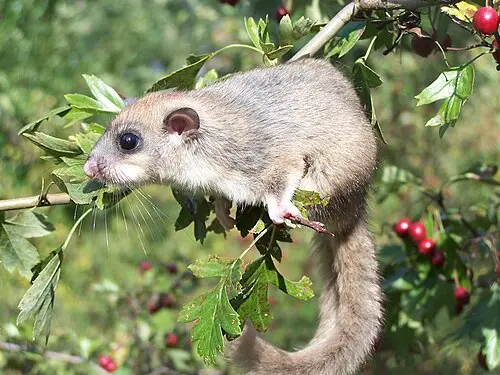
 📸 Photo
Photo: Azay · CC BY-SA 3.0 · Wikimedia Commons Source
European Fat Dormouse
Glis glis (European Fat Dormouse · オオヤマネ)
💡 Everyday Comparisons for Size, Mass & Speed
- 💡 Its maximum weight of 150 g equals two and a half chicken eggs (about 60 g each), and its length of 19 cm is slightly shorter than the short side of A4 paper (21 cm) (Comparison).
- 💡 Trapped and hunted for its soft fur, for meat, and for sport, it also shelters in human buildings such as attics and barns (Animal Diversity Web).
Reference standards: coach bus ~12 m, mid-size car ~4.9 m, compact car ~1 t, basketball hoop 3.05 m, credit card 8.56 cm.
Site-computed relative index from recorded values; not a formal scientific metric.
📖 1. Overview
The European Fat Dormouse is a small, plump rodent living in deciduous forests of Europe that is active in trees at night and sleeps deeply through winter hibernation.
🦴 2. Anatomy & Morphology
With short legs, a compact body, and a bushy tail, it resembles a squirrel. It has four toes on the front feet and five toes on the hind feet, with short, curved claws.
🔍 3. Ecology & Behavior
It feeds mainly on beech mast, acorns, hazelnuts, and fleshy fruits, and also eats insects, fungi, and bird eggs. It practices daily torpor, hibernation, and aestivation, and breeds only in mast-rich years, giving birth to an average of 5 young per litter.
🇰🇷 4. Connection to Korea
No direct record connecting this species to Korea has been found.
📚 Sources & References
- • IUCN Red List LC (2021) — https://www.iucnredlist.org/species/39316/197292692
- • IUCN Red List category LC — latest assessment at iucnredlist.org
- • mammaldiversity.org — 1001506
- • iucnredlist.org — 197292692
- • wikidata.org — Q147128
- • commons.wikimedia.org — File:Glis glis 4058.JPG
- • animaldiversity.org — Glis glis
- • Silhouette: PhyloPic — Ferran Sayol · CC0 1.0
Recorded dimensions are widely cited representative estimates from public literature and may vary by study or specimen.