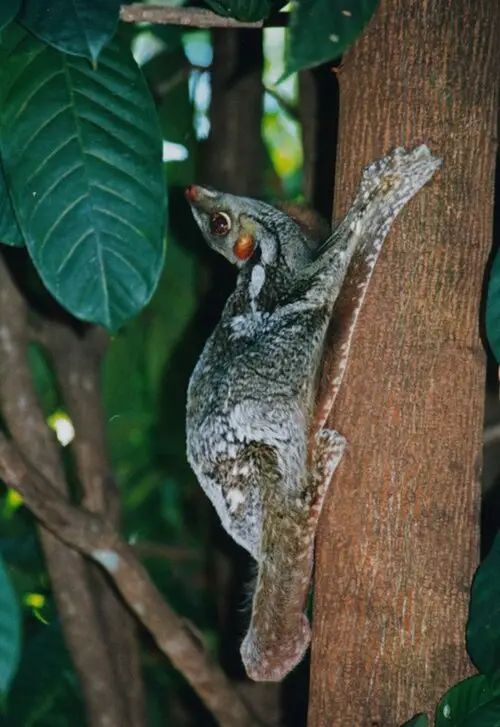
 📸 Photo
Photo: Nina Holopainen · CC BY 2.5 · Wikimedia Commons Source
Sunda Colugo
Galeopterus variegatus (Sunda Colugo · マレーヒヨケザル)
💡 Everyday Comparisons for Size, Mass & Speed
- 💡 Its 70 cm spread membrane equals the length of two and a half 30 cm rulers, and its weight of 2 kg is about one and a half 1.5 L bottles of water (Comparison).
- 💡 It is sometimes hunted for meat and fur, and because it adapts to fruit plantations it is also viewed as a crop pest.
Reference standards: coach bus ~12 m, mid-size car ~4.9 m, compact car ~1 t, basketball hoop 3.05 m, credit card 8.56 cm.
Site-computed relative index from recorded values; not a formal scientific metric.
📖 1. Overview
The Sunda Colugo cannot fly, but glides between trees by spreading the skin membrane along its sides, and is known as the closest living relative of primates. It spends its entire life in the treetops.
🦴 2. Anatomy & Morphology
A fur-covered gliding membrane (patagium) stretches from its neck to its fingers, toes, and tail, spanning about 70 cm when spread. Its mottled white, gray, black, and reddish coat looks like tree lichen, and its lower incisors are comb-shaped.
🔍 3. Ecology & Behavior
Active mostly at night, it eats only soft plant parts such as fruits, flowers, buds, young leaves, nectar, and sap. It can glide over 100 m with very little loss of height, and after about 60 days of gestation females give birth to a single young that clings to the mother's belly as she moves.
🇰🇷 4. Connection to Korea
No direct record connecting this species to Korea has been found.
📚 Sources & References
- • IUCN Red List LC (2008) — https://www.iucnredlist.org/species/41502/10479343
- • IUCN Red List category LC — latest assessment at iucnredlist.org
- • mammaldiversity.org — 1000535
- • iucnredlist.org — 10479343
- • wikidata.org — Q5198886
- • commons.wikimedia.org — File:Kaguaani 02.jpg
- • animaldiversity.org — Galeopterus variegates
- • Silhouette: PhyloPic — Yan Wong · CC0 1.0
Recorded dimensions are widely cited representative estimates from public literature and may vary by study or specimen.