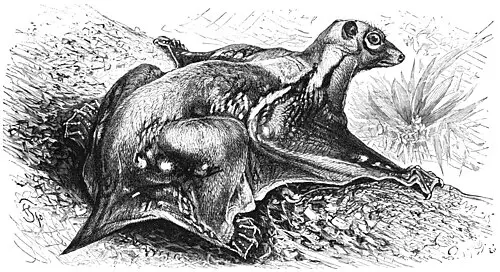
 📸 Photo
Photo: Public domain · Public domain · Wikimedia Commons Source
Philippine Colugo
Cynocephalus volans (Philippine Colugo · フィリピンヒヨケザル)
💡 Everyday Comparisons for Size, Mass & Speed
- 💡 It can glide up to 150 m in a single bound, which is longer than a soccer field (about 105 m) (Comparison).
- 💡 Because it lives near coconut and rubber plantations, plantation owners often regard it as a pest, and it is also hunted for its meat and fur for making hats.
Reference standards: coach bus ~12 m, mid-size car ~4.9 m, compact car ~1 t, basketball hoop 3.05 m, credit card 8.56 cm.
Site-computed relative index from recorded values; not a formal scientific metric.
📖 1. Overview
Despite its Korean name meaning 'Philippine flying monkey,' the Philippine Colugo is neither a monkey nor capable of true flight, but an arboreal animal of the Philippines that glides between trees.
🦴 2. Anatomy & Morphology
It has a wide gliding membrane (patagium) stretching from its neck to the tips of its fingers, toes, and tail, and comb-shaped lower incisors. Its fur is brown to gray.
🔍 3. Ecology & Behavior
A nocturnal folivore, it feeds on young leaves, flower buds, fruits, and ants. It gives birth to one young at a time, glides with the young held against its belly, and rests in tree hollows during the day.
🇰🇷 4. Connection to Korea
No direct record connecting this species to Korea has been found.
📚 Sources & References
- • IUCN Red List LC (2008) — https://www.iucnredlist.org/species/6081/12410826
- • IUCN Red List category LC — latest assessment at iucnredlist.org
- • mammaldiversity.org — 1000534
- • iucnredlist.org — 12410826
- • wikidata.org — Q1097901
- • commons.wikimedia.org — File:Kaguang-drawing.jpg
- • tb.plazi.org — 997787B3FFE6FFBB58D96E0AFB9B4E97
- • animaldiversity.org — Cynocephalus volans
- • Silhouette: PhyloPic — Margot Michaud · CC0 1.0
Recorded dimensions are widely cited representative estimates from public literature and may vary by study or specimen.