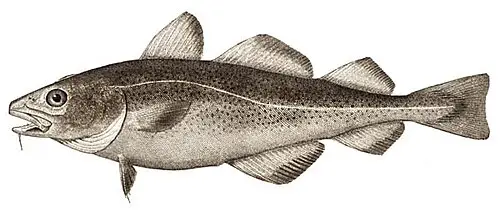
 📸 Photo
Photo: Public domain · Public domain · Wikimedia Commons Source
Atlantic cod
Gadus morhua (Atlantic cod · タイセイヨウダラ)
💡 Everyday Comparisons for Size, Mass & Speed
- 💡 Its average weight of 40 kg is the weight of 2 bags of rice weighing 20 kg each (Comparison).
- 💡 Its maximum length of 2 m is similar to the height of a doorway (Comparison).
- 💡 Its mild flesh makes it a popular table fish, and its liver is used to make cod liver oil (ADW).
- 💡 Until the 1990s, it was the economic pillar of New England and Canadian fisheries, earning it the nickname Newfoundland currency (ADW).
Reference standards: coach bus ~12 m, mid-size car ~4.9 m, compact car ~1 t, basketball hoop 3.05 m, credit card 8.56 cm.
Site-computed relative index from recorded values; not a formal scientific metric.
📖 1. Overview
The Atlantic cod is a large marine fish living in the cold waters of the North Atlantic that was long the centerpiece of North American and European fisheries.
🦴 2. Anatomy & Morphology
It has 1 barbel under the chin, 3 dorsal fins, and 2 anal fins. Its body color varies by habitat from red to greenish and gray, and a distinct lateral line runs from the gills to the tail.
🔍 3. Ecology & Behavior
It is an opportunistic predator that eats almost anything it can catch, with adults eating squid, mussels, clams, and even other cod. It produces antifreeze proteins that keep its blood from freezing even in very cold waters.
🇰🇷 4. Connection to Korea
No direct record connecting this species to Korea has been found.
📚 Sources & References
- • IUCN Red List VU (1996) — https://www.iucnredlist.org/species/8784/12931575
- • IUCN Red List category VU — latest assessment at iucnredlist.org
- • catalogueoflife.org — 6K72F
- • iucnredlist.org — 12931575
- • wikidata.org — Q199788
- • commons.wikimedia.org — File:Atlantic cod.jpg
- • animaldiversity.org — Gadus morhua
- • fishbase.se — Gadus-morhua.html
- • fisheries.noaa.gov — atlantic-cod
- • Silhouette: PhyloPic — Alexandra Hahn · CC0 1.0
Recorded dimensions are widely cited representative estimates from public literature and may vary by study or specimen.