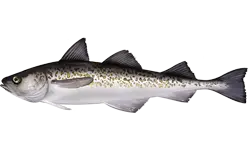
 📸 Photo
Photo: Unknown author Unknown author · Public domain · Wikimedia Commons Source
Alaska pollock
Gadus chalcogrammus (Alaska pollock · Alaska pollock)
Not Evaluated (NE) on the IUCN Red List yet.
💡 Everyday Comparisons for Size, Mass & Speed
- 💡 Its maximum total length of 91 cm is 9 cm shorter than a 1 m ruler (Comparison).
- 💡 Its maximum weight of 3.9 kg is similar to a single 4 kg bag of rice (Comparison).
- 💡 It is a heavily fished commercial species (FishBase). Spawning adults are also caught to harvest their roe.
- 💡 According to NOAA, it typically measures 30–50 cm in length and weighs 1–3 pounds (about 0.5–1.4 kg).
Reference standards: coach bus ~12 m, mid-size car ~4.9 m, compact car ~1 t, basketball hoop 3.05 m, credit card 8.56 cm.
Site-computed relative index from recorded values; not a formal scientific metric.
📖 1. Overview
The Alaska pollock is a North Pacific marine fish in the cod family, widely distributed from Norway to Korea and California in the United States. It is a heavily fished commercial species.
🦴 2. Anatomy & Morphology
A member of the cod family, it has speckled markings resembling the sea floor that help it avoid predators. Its maximum length has been reported at 91 cm and its maximum lifespan at 28 years.
🔍 3. Ecology & Behavior
It mainly feeds on krill and also eats fishes and crustaceans. Adults usually live near the bottom but sometimes come near the surface, making daily vertical migrations. It grows quickly, has a relatively short lifespan (about 12 years), and begins breeding at 3–4 years of age.
🇰🇷 4. Connection to Korea
South Korean waters are included in its distribution range in FishBase.
📚 Sources & References
- • IUCN Red List: not evaluated (NE) — cross-checked with the Wikidata conservation-status entry
- • catalogueoflife.org — 6K6PF
- • wikidata.org — Q28752183
- • commons.wikimedia.org — File:Theragra chalcogramma.png
- • fishbase.se — Gadus-chalcogrammus.html
- • fisheries.noaa.gov — alaska-pollock
- • Silhouette: PhyloPic — Tessa Rehill · CC0 1.0
Recorded dimensions are widely cited representative estimates from public literature and may vary by study or specimen.