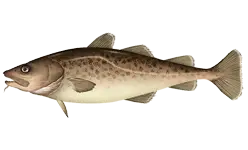
 📸 Photo
Photo: Unknown author Unknown author · Public domain · Wikimedia Commons Source
Pacific cod
Gadus macrocephalus (Pacific cod · マダラ)
Not Evaluated (NE) on the IUCN Red List yet.
💡 Everyday Comparisons for Size, Mass & Speed
- 💡 Korea Policy Briefing introduced the Pacific cod as a seafood of the month for December, sharing how to make cod steak from its chewy, mild flesh.
- 💡 Its maximum length of 119 cm is about 70% of an adult human height (about 1.7 m) (Comparison).
- 💡 Its maximum weight of 22.7 kg is slightly heavier than a 20 kg bag of rice (Comparison).
Reference standards: coach bus ~12 m, mid-size car ~4.9 m, compact car ~1 t, basketball hoop 3.05 m, credit card 8.56 cm.
Site-computed relative index from recorded values; not a formal scientific metric.
📖 1. Overview
The Pacific cod is a large schooling marine fish of the cold North Pacific, distributed as far west as the Yellow Sea.
🦴 2. Anatomy & Morphology
It is known to reach a maximum total length of 119 cm and a maximum weight of 22.7 kg, with a recorded lifespan of up to 25 years.
🔍 3. Ecology & Behavior
Adults feed on fishes, octopuses, and large bottom crustaceans, and move to spawning grounds at depths of 100–250 m between late summer and midwinter to spawn once a year.
🇰🇷 4. Connection to Korea
It is listed on the National List of Species of Korea (National Institute of Biological Resources (NIBR)), and Korea's National Institute of Fisheries Science revealed through biologging that Pacific cod stay at the Jinhae Bay spawning grounds for up to 15–16 days, and up to 7 days in the main spawning area.
📚 Sources & References
- • IUCN Red List: not evaluated (NE) — cross-checked with the Wikidata conservation-status entry
- • catalogueoflife.org — 6JV2L
- • 국가생물종목록(국립생물자원관) ktsn 120000057858 — https://species.nibr.go.kr/home/mainHome.do?cont_link=009&subMenu=009002&contCd=009002&ktsn=120000057858
- • wikidata.org — Q783575
- • commons.wikimedia.org — File:Gadus macrocephalus.png
- • fishbase.se — Gadus-macrocephalus.html
- • species.nibr.go.kr — general-search
- • nifs.go.kr — actionContentsCons0073.do
- • korea.kr — cultureColumnView.do
- • Silhouette: PhyloPic — Alexandra Hahn · CC0 1.0 (Congeneric silhouette — Gadus morhua)
Recorded dimensions are widely cited representative estimates from public literature and may vary by study or specimen.